
Ballet fantastique in three acts and four scenes
Music by Peter Ilyich Tchaikovsky
Libretto by Vladimir Begichev, edited by Modeste Tchaikovsky
Décor by Ivan Andreyev (Act 1, scene 1), Mikhail Bocharov (Act 1, scene 2, Act 3, Apotheosis) and Heinrich Levogt (Act 2)
Costumes by Evgeni Ponomarev
World Première
4th March [O.S. 20th February] 1877
Imperial Bolshoi Theatre, Moscow
Choreography by Julius Reisinger
Original 1877 Cast
Odette/Odile
Polina Karpakova
Prince Siegfried
Victor Gillert
Von Rothbart
Sergey Sokolov
Benno
Sergey Nikitin
Wolfgang
Wilhelm Wanner
The Princess Regent
Olga Nikolayeva
Première of Petipa and Ivanov’s revival
27th January [O.S. 15th January] 1895
Imperial Mariinsky Theatre, Saint Petersburg
Original 1895 Cast
Odette/Odile
Pierina Legnani
Prince Siegfried
Pavel Gerdt
The Evil Genie/Von Rothbart
Alexei Bulgakov
Benno
Alexander Oblakov
Wolfgang
Stanislav Gillert
The Queen
Giuseppina Cecchetti
Act 1
Pas de trois
Georgy Kyaksht
Olga Preobrazhenskaya
Varvara Rykhliakova
Cygnets
Varvara Rykhliakova
Evgenia Voronova
Vera Ivanova
Anna Noskova
Big Swans
Ekaterina Ofitserova
Evgenia Obukhova
Lydia Feodorova
Mlle. Rykhliakova II
Act 2
Spanish Dance
Maria Skorsiuk
Alexander Shiryaev
Evgenia Obukhova
Sergei Litavkin
Czardas
Marie Petipa
Alfred Bekefi
Act 3
Two Swans
Anna Johansson
Claudia Kulichevskaya

History
Tchaikovsky’s first ballet
Swan Lake was the first ballet by Peter Ilyich Tchaikovsky. Following his graduation from the Saint Petersburg Conservatoire in 1865, Tchaikovsky moved to Moscow where he was given his first employment as a teacher in Russia’s second conservatoire by Nikolai Rubenstein. On the 14th November 1865, Rubenstein founded a new club called “the Artistic Circle”, a social forum that brought together various people involved in different branches of the arts – dance, music, drama, stage designs, etc. Tchaikovsky joined this club and it paved the way for some of his biggest successes, for it was within this club that he met Alexander Ostrovsky, with whom he collaborated on his opera The Voyevoda and the play The Snow Maiden. Tchaikovsky also witnessed the creation of a new ballet by the ballet artists who were members of the club for the Imperial Bolshoi Ballet. The ballet in question was entitled The Fern, which was based on an old Russian folk tale and was adapted into a ballet libretto by Konstantin Shilovsky, who would later work with Tchaikovsky on the libretto for his opera Eugene Onegin. The composer of the music score was Yuli Gerber, a violinist and conductor of the Bolshoi Ballet orchestra and the choreography was by the Bolshoi dancer Sergei Sokolov, who had created other ballets for the company during its years without a leader in the 1860s. The Fern premièred on the 27th December 1867, but, although it presented to the Moscow audience a Russian ballet created by Russians, it was not successful, probably because its creators were too inexperienced in producing a ballet to overcome all the problems that stood in the way of success. Nevertheless, The Fern plays an important role in the history of the Moscow ballet. Although it has no direct connections to the origins of Swan Lake, many historians believe that it was within the Artistic Circle that the idea of what would be Tchaikovsky’s first ballet began, since some of those who collaborated on the original production were members of the club.
After the failure of The Fern, Tchaikovsky seems to have suggested composing a new ballet version of Cinderella, writing to his brother Modeste:
“Among other things, think that I took it upon myself to write music the ballet Cinderella and that the huge four-act score must be ready in mid-December!”1
However, Tchaikovsky’s Cinderella never came into fruition, as he discontinued work on the project for unknown reasons. Nevertheless, the fairy tale would still be used for a ballet that would bring the Czech Ballet Master Julius Reisinger to Moscow that same year. The libretto for a Cinderella ballet was written by the machinist Karl Valts, another member of the Artistic Circle, and Valts presented it to the theatre’s directorate, who accepted it. A composer named Mühldorfer was commissioned to compose the score and in the search for a choreographer, Reisinger was chosen and invited to Moscow. It is unclear why Reisinger was chosen as choreographer for the new ballet; it is possible that perhaps Valts recommended him, but the true reason remains a mystery. The première of Cinderella took place on the 1st March 1872, but was not well received. Reisinger applied for the post of Premier Maître de Ballet of the Imperial Bolshoi Theatre, but was rejected due to some disagreements regarding his conditions for accepting the post. However, after the Minister of Court A. V. Alderberg reviewed the Moscow theatres and was not happy with the condition of the company, Reisinger was appointed Ballet Master on the 6th October 1873, despite his previous rejection for the role. As Ballet Master, however, Reisinger’s tenure appears to have been an artistic failure. In 1873, he staged a new ballet Kashchei and in 1875, he staged another ballet entitled Stella, neither of which were met with success. A few months after the première of Stella, he began work on Swan Lake.
Origins inspiration
Tchaikovsky was commissioned to compose Swan Lake in 1875 by Vladimir Begichev, a ranking theatre official and former artistic manager of the Bolshoi Theatre, who determined the repertoire of the company. A fan of ballet, Tchaikovsky was very excited by the commission and quickly began work on the composition, but the journey of Swan Lake had begun several years earlier in the summer of 1871 in Kamenka, Ukraine. While Tchaikovsky was on holiday and staying with his sister Alexandra and her family on their Kamenka estate, during that holiday, he composed and choreographed an impromptu house ballet called The Lake of the Swans for his nieces and nephews. What would be his first ballet would be an expansion of this little ballet. His nephew Yuri Davydov (Alexandra’s son) wrote the following account of The Lake of the Swans, which he learned from his elder sisters since he was born in 1876:
A celebrated event was the production by Peter Ilyich of a ballet, in which my older sisters and Uncle Modeste participated. The ballet was created by Peter Ilyich, as was also the music, on the theme The Lake of Swans. Of course, this was not the ballet which is given on stages now, but a children’s one-act short ballet, although the principal theme – The Song of the Swans – was then the same as now. Peter Ilyich in his later, large composition used the theme of the children’s ballet of 1871.2
Yuri’s sister Anna, who would have been seven years old in 1871 and performed in the little ballet, wrote this account:
He [Tchaikovsky] very much loved to produce all manner of house performances. The first production, barely in my memory, was Swan Lake’ My sister participated; she was six. My Uncle Modeste Ilyich performed the role of the prince. I represented Cupid… The magnificent wood swans on which we rocked were in the house for a long time.3
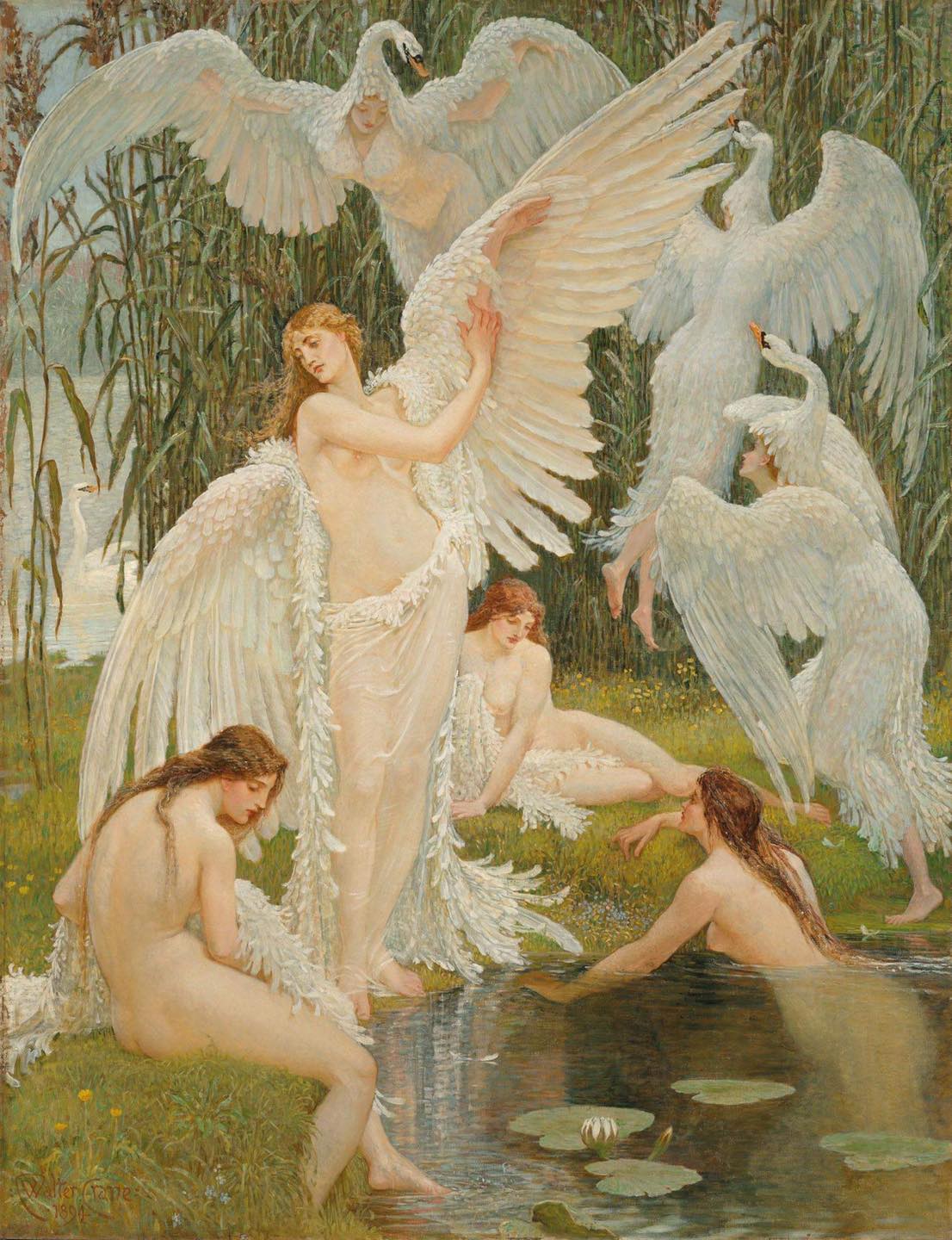
Tchaikovsky’s aim was to create a ballet that told a Romantic story or fairy tale like the Romantic ballets of the early to mid-19th century with the troupe of a supernatural woman falling in love with a mortal man that ended in tragedy, which was not something Tchaikovsky had strayed from using before. He had used this storyline in his operas Undina (1869) and Mandragora (1869-70) – both operas never premièred, however, because Tchaikovsky destroyed the score for Undina and abandoned Mandragora – and Ostrovsky’s play The Snow Maiden (1873), for which he composed incidental music. For Swan Lake, the libretto was based on European legends about people turning into birds, more specially, the mythical swan maidens, who mostly appear in Norse and Germanic folklore and mythology. According to the legend, swan maidens are fairy maidens (sometimes, valkyries), who take the guise of swans by wearing swan skins. When they shed their skins, they are revealed to be beautiful young women (see fig. 2). In the typical legend, a young unmarried man encounters a swan maiden and steals her swan skin so she cannot fly away. He subsequently marries her, she bears him children and proves to be an excellent wife, but she longs to return to her faraway homeland. One day, the children discover their mother’s swan skin that their father had hidden and although she loves her family, the swan maiden immediately takes her swan skin back and flies away. In some versions, she never returns, but in others, her husband is given the chance to find her and bring her back.
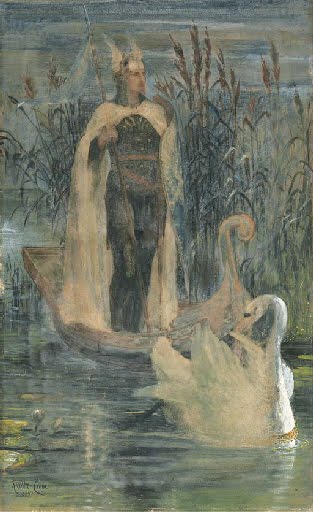
The legend of the swan maiden was written and published as poems and fairy tales across Europe. One such story was a fairy tale entitled The Stolen Veil by the German writer Johann Karl August Musäus and according to the Soviet historian, Yuri Slominsky, it was The Stolen Veil that inspired the libretto for Swan Lake. Another possible source of inspiration were the works of one of Tchaikovsky’s favourite composers Richard Wagner, specifically the operas Der Ring, Lohengrin and Tannhäuser. The name for the Prince in Tchaikovsky’s new ballet may have been taken from Wagner’s hero Siegfried in Der Ring, just like the name Benno could have taken from The Stolen Veil, and both Siegfrieds share the common fate of death after inadvertently betraying their respective beloveds. Lohengrin is based on a German Arthurian legend and the titular hero is known as ‘the Knight of the Swan’, a medieval tale about a hero who comes in a boat driven by a swan to rescue a damsel (see fig. 3), which Wagner retained when he composed his opera.
There is some uncertainty as to who wrote the ballet’s libretto, which was finished before the 19th October 1876, though according to Modeste Tchaikovsky, it was written by Begichev and the Bolshoi dancer Vasily Geltser.
Composition
Tchaikovsky began composing the score for Swan Lake in early 1875. His enthusiasm in the project is clear from the speed at which he wrote the score for by the summer of that same year, he had already composed two acts. He seems to have begun work on the orchestration between October and December and finally, the score was finished in April 1876. One vital requirement he needed for the composition was instructions from Reisinger for the requirements of each dance since he had to know what sort of dances were required, what tempo they were to be in, how long they were to be, etc. Unlike the instructions he received for the scores of The Sleeping Beauty and The Nutcracker, however, no such written instructions for Swan Lake are known to have survived. In correspondence, Tchaikovsky mentions working from a scenario by Reisinger, but it seems that he worked with only a very basic outline without any detailed knowledge of Reisinger’s requirements. This led to Tchaikovsky visiting the theatre library and studying various ballet scores so he could understand what sort of details in relation to tempo, etc, were required for this kind of composition. It is known that Reisinger requested a Russian Dance, but any other details he may have asked for remain unknown.

The only insight into collaboration between Tchaikovsky and Reisinger are the holograph score and a published poster that listed numbers from the ballet, but this only proves that the collaboration was very distant. The poster contained entries that had no counterpart in Tchaikovsky’s holograph score and the holograph often differs from the libretto. A plausible explanation is that Reisinger reordered the numbers Tchaikovsky composed, but no documents detailing any edits he made have survived. It seems this was a collaboration in which the two men decided on a scenario for their new ballet and then went their separate ways to prepare their material – Tchaikovsky composed the score, to which Reisinger set his choreography only after it was completed.
Tchaikovsky was especially influenced by the ballet music of Léo Delibes and Adolphe Adam, but especially the latter with his use of leitmotifs in the score for Giselle, a feature that Tchaikovsky would use in his own ballet score, which came to life in the most famous music number of Swan Lake – the famous Swan’s Theme, named The Song of the Swans by his nephew Yuri, which he had composed years earlier for The Lake of Swans. Tchaikovsky would use the Leitmotif technique again in The Sleeping Beauty for the respective themes of the Lilac Fairy and Carabosse. The Song of the Swans has since gone onto become one of his most famous and celebrated compositions. Tchaikovsky also introduced elements from the discarded Undina, for although he abandoned the opera and destroyed the score, he adapted and recycled five extracts and used them in other works. For Swan Lake, he inserted a duet between the lovers Undina and Huldbrand entitled O happiness, O blessed moment into the second act as the duet of Odette and Prince Siegfried (No. 13-V), with the vocal parts given to solo cello and violin.
Original libretto
The libretto for the 1877 production is similar to that of the 1895 production, but they are more different than meets the eye. The first act takes place in the park of a medieval German castle where Prince Siegfried is celebrating his coming of age. The young prince is drinking wine with his friends, among whom is the knight Benno, peasants and his tutor Wolfgang. Siegfried treats the men to wine, while Wolfgang pays court to the women and gifts them with ribbons and bouquets. The peasants dance a waltz, but afterwards, a messenger runs in and announces the arrival of Siegfried’s mother, the Princess Regent, who enters with her suite and begins to converse with her son, explaining she has not come to break up the party, but to discuss with him his marriage, for which the day of his coming of age was selected. However, Siegfried is not yet inclined towards marriage and asks his mother who is to be his bride. She explains she has not chosen anyone and that he will choose a bride from the many young noblewomen and princesses who will be attending a ball at the castle the following evening. Siegfried is reluctant, but complies to his mother’s wishes. After she departs, the celebrations continue. Wolfgang, who is now drunk, attempts to join in the dancing and court the peasant girls, but he is laughed at and the girls run away from him. One he especially likes, and as a preliminary to declaring his love, he wants to kiss her, but she avoids him and instead, kisses her suitor. The tutor turns around and fall, provoking laughter from all present. As night approaches, the peasants come together for a final dance with cups in hand and then take their leave. Benno suddenly spots a flock of swans flying overhead and suggests to Siegfried they end the evening with a hunt.
The second act takes place at a lake deep in the forest where the ruins of an old chapel lie. Swans swim on the lake and their leader wears a crown on its head. Siegfried and Benno arrives and attempt to shoot the flock, but the swans disappear into the ruins and transform into beautiful young women. The most beautiful of them is their leader Odette, who begs the two men to lower their crossbows. The astonished Siegfried and Benno comply and Odette tells her story – she is the daughter of a good fairy and a mortal knight, but her father destroyed her mother. After her mother’s death, her father remarried, this time to an evil sorceress who hated Odette and tried to kill her, but her maternal grandfather took her in. As her grandfather mourned the loss of his daughter, his tears formed the lake and he went to a place in the deepest part of the forest and concealed Odette from people. He then began to indulge her and gives her full freedom to make merry, allowing her and her friends to transform into swans by day and merrily fly through the sky and by night, they resume their womanly forms and dance and play by the lake near Odette’s dear grandfather. However, her evil stepmother stalks her and her friends in the guise of a huge owl and Odette is only protected by the magical crown she wears that was given to her by her grandfather. If she marries, her stepmother’s evil intentions will be thwarted. As the night goes on, the swan maiden make merry, dancing on the shore and Siegfried and Benno join in their merry-making. Siegfried falls in love with Odette and declares his love, but she mistrusts him and does not believe him, telling him that she believes he will swayed by the other beautiful other women who will attend the ball the following evening. Upset by her lack of trust, Siegfried swears he will never forget Odette and invites her to attend the ball, promising to choose her as his bride. Touched by his declarations, she admits that she loves him too but warns him that her stepmother will plot a wicked scheme to ruin their happiness. Dawn approaches, Odette and her friend return to the ruins. The sun rises and the flock of swan appears on the lake, with the owl flying above them.
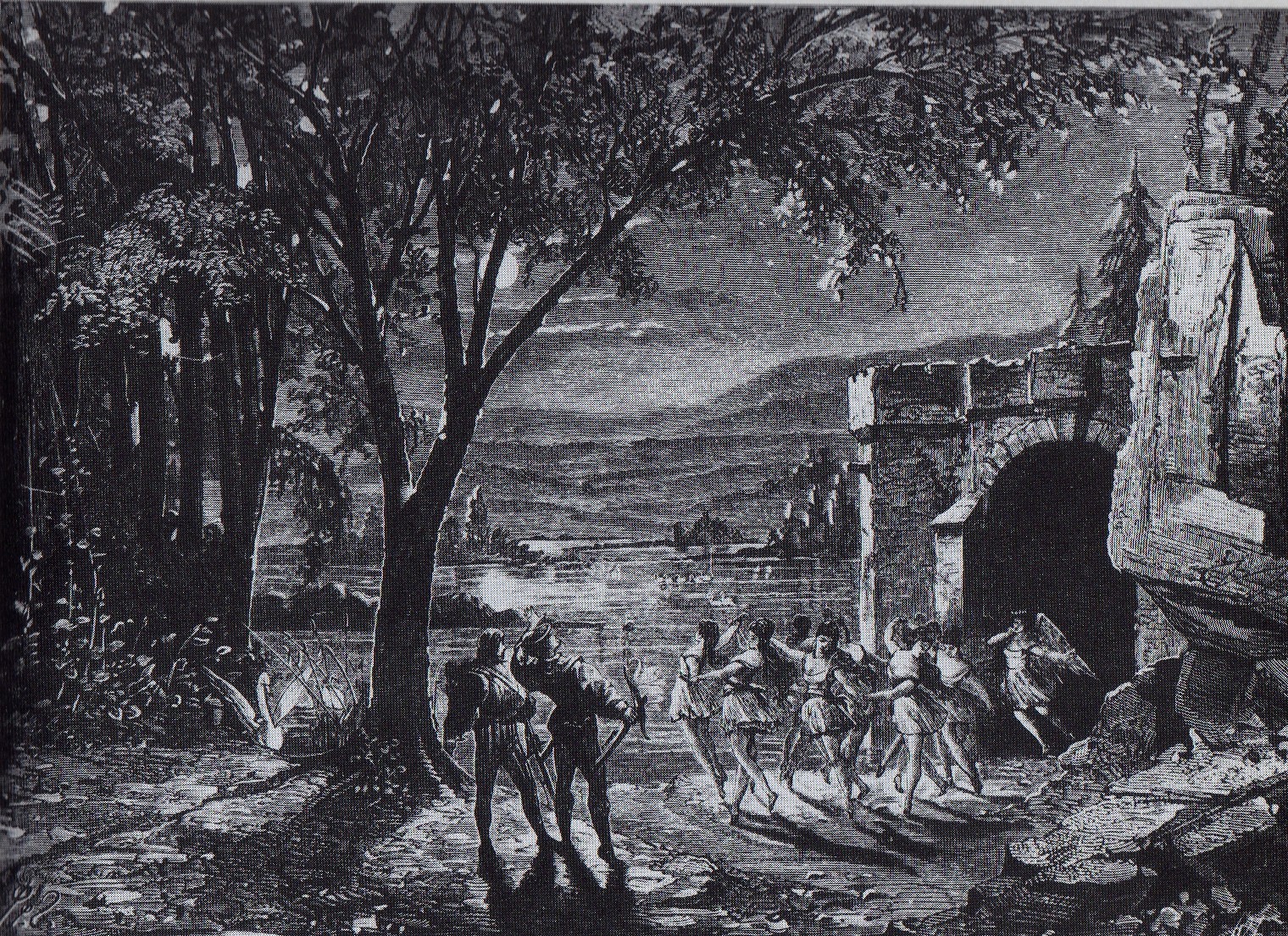
The third act takes place at the castle where the ball begins. Siegfried arrives with his mother and Benno and the Master of Ceremonies introduces the guests. Various nobles arrive with their daughters, who are presented as potential brides for the Prince. The Princess Regent calls for the dances to begin and asks her son if any of the young women please him, but he disappoints her when he replies that he loves none of them. Suddenly, the trumpets sound and enter Von Rothbart and his daughter Odile. Siegfried is struck by Odile’s beauty and believes he is seeing his beloved Odette, but Benno swears there is no resemblance between the two women. As Odile dances, Siegfried becomes more entranced by her and joins in the dancing, preferring her to the others. When the dancing is over, Siegfried kisses Odile’s hand, choosing her as his bride, declaring his eternal love. At that moment, the castle darkens, the cry of an owl rings out and Von Rothbart turns into a demon, while Odile bursts out laughing. The window flies open, revealing a white swan wearing a crown on her head. Horrified, Siegfried flees, following Odette back to the lake.
The fourth act takes place back at the lake, where the swan maidens are awaiting Odette’s return. Sad without her, they try to amuse themselves by dancing and teaching the cygnets how to dance. Odette arrives in despair, telling them of Siegfried’s betrayal. Her friends try to comfort her and urge to forget him but realising that he is following her, she wishes to see one last time. Siegfried rushes in as a storm brews and begs Odette for forgiveness, but she explains that she is powerless to forgive him and they will never see each other again. But the selfish Siegfried declares that they will never to be parted. He rips the crown from Odette’s head and throws it into the stormy lake, which is overflowing its banks. Distraught, Odette tells him that he has now doomed her to death and she falls into his arms . The waters of the overflowing lake engulf them and they are drowned as the owl watches from above: the wicked stepmother is triumphant. As dawn approaches, the storm quiets and the lake calms. The sun rises and the swans appear on the lake.
Casting
Rehearsals for the first act began on the 23rd March 1876 and Reisinger spent eleven months choreographing the ballet. Tchaikovsky attended rehearsals, but he would watch as a spectator rather than a collaborator. When the casting was decided, Olga Nikolayeva was cast as the Princess Regent; Nikolayeva had been Prima Ballerina of the Bolshoi Theatre in 1860s, but was restricted to mime roles after a serious fall when dancing Giselle in 1869. Sergei Sokolov, choreographer of The Fern, was cast as Von Rothbart and Wilhelm Verner was cast as Wolfgang. The principal roles of Prince Siegfried and Odette/Odile were given to the Bolshoi Theatre’s Premier Danseur Victor Gillert and the ballerina Polina (Pelagaya) Karpakova, the ballet’s first performance was held as a benefit for Karpakova. Originally, the Bolshoi Theatre’s Prima Ballerina Anna Sobeschanskaya was cast as Odette/Odile, but she was withdrawn from the première and was given the role in the ballet’s fourth performance instead, though the reason for this change in the casting is unclear. According to Karl Valts, it was due to a scandal involving Sobeschanskaya and a government official. Like many ballerinas, Sobechanskaya enjoyed the favour of many government officials, among whom was the Governor-General of Moscow, Vladimir Dolgorukov. Dolgorukov made a complaint against the ballerina, claiming he had presented her with gifts from his family jewel chest. Sobeschanskaya accepted the jewellery from him, but fell in love with Gillert, married him and sold the jewellery. This resulted in her period of service with the theatre being cut short and her deprivation from all future benefit performances, including the traditional farewell benefit. However, another theory says that Sobeschanskaya withdrew herself from the première because she found the new ballet very unsatisfactory and only wished to dance choreography by Petipa, but at the time, he was unavailable to provide anything for her.
World Première
Swan Lake made its world première at the Imperial Bolshoi Theatre on the 4th March [O.S. 20th February] 1877. The première has widely believed to have been a failure, but that was not really the case. Reaction to the ballet was, at best, lukewarm. It is true that some criticised the dancers, orchestra and décor, and Tchaikovsky’s score, which they deemed “too noisy”, “too Wagnerian”, “too symphonic” and too complicated for ballet. However, it was Reisinger’s choreography that received the sharpest criticism, which many thought was “unimaginative” and “unmemorable”, but there some who saw the potential for this new ballet, especially Tchaikovsky’s score, which is made clear by the fact that the ballet would remain in the Moscow repertoire for six years. Nevertheless, this was not the reaction that the sensitive Tchaikovsky had hoped for and it was the composer himself who deemed his first ballet a failure.
Subsequent performances and revivals
On the 8th May [O.S. 26th April] 1877, Sobeschanskaya made her début as the Swan Queen and by this point, new choreography and new music had been added to Swan Lake at her request. Sobeschanskaya did not trust Reisinger and was unsatisfied with Tchaikovsky’s music, so, before her début, she turned to the choreographer she did trust, Petipa. Without consulting Tchaikovsky, she travelled to Saint Petersburg to ask Petipa to create a new pas de deux for her in the third act and Petipa agreed. This was not the first time Petipa had granted such a request for Sobeschanskaya, for she had turned to him for new choreography before two years earlier when she had danced in Reisinger’s ballet Ariadne. For her performance in Swan Lake, Petipa created new variations to music by Ludwig Minkus. When Sobeschanskaya returned to Moscow, she informed the Kapellmeister that she had acquired a new pas de deux that she wished to interpolate into the third act of Swan Lake. However, when Tchaikovsky learned of this, he was justifiably furious, making it clear that whether his ballet was good or bad, he alone should have full responsibility for the music.
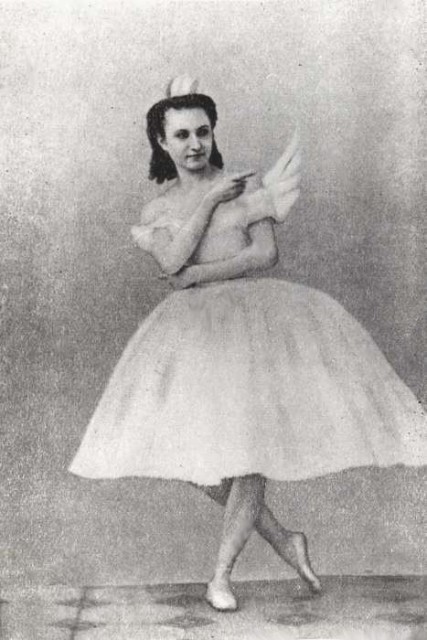
After long discussions, he promised to compose a new pas de deux for Sobeschanskaya, but this did not immediately resolve the problem because the ballerina did not want to change the choreography that Petipa was created for her, nor did she want to travel to Saint Petersburg again. The only solution to this issue, therefore, was to compose new music for the existing choreography and Tchaikovsky took it upon himself to resolve the problem in this manner. Using the music composed by Minkus, he promised to compose new music that would agree bar for bar, note for note with Minkus’s music to which Petipa’s choreography could be performed without any changes. Tchaikovsky quickly composed the new pas de deux and when hearing the finished music, Sobeschanskaya was so pleased that she asked Tchaikovsky to compose a new variation for her, which he did. Sobeschanskaya performed the new pas de deux in the third act of Swan Lake in place of the original Pas de six (and would again in her subsequent performances) and the new number was a success in its own right.
Eventually, this pas de deux disappeared from the Moscow repertoire and was not published with the full Swan Lake score. For seventy years, it was forgotten and/or unknown of until in 1953 when it was accidentally discovered in the archives of the Bolshoi Theatre and revived for a new production of Swan Lake staged at the Stanislavsky and Nemirovich-Danchenko Theatre. It also came to the attention of George Balanchine, who successfully applied for permission to use it for choreography. Balanchine used the music to choreograph his famous Tschaikovsky Pas de deux, which premièred on the 29th March 1960 at the City Center of Music and Drama in New York, performed by Violette Verdy and Conrad Ludlow.
Swan Lake remained active in the Moscow repertoire for six years and subsequently went through several revivals and numerous changes. In January 1878, Karpakova replaced the Pas de six of the third act with a pas de dix, but it remains unclear if this was the original pas de six with four more dances added or a new number altogether. By the end of 1879, Sobeschanskaya, Gillert, Karpakova and Reisinger had all left Moscow and the Imperial Bolshoi Ballet was now in the hands of Reisinger’s successor Joseph Peter Hansen. Between 1880 and 1883, Hansen staged several revivals of Swan Lake, although information on these stagings is very scarce, with many details about the productions unknown. The first of Hansen’s revivals was staged for his benefit performance on the 25th January [O.S. 13th January] 1880, with a student, Evdokia Kalmykova as Odette and Alfred Bekefi as Prince Siegfried. For this production, Hansen changed the outline of the ballet, adding a seduction scene to the first act and choreographed a pas with garlands to the Dance with the Goblets, retained all the national dances and Sobeschanskaya’s pas de deux in the third act. Reaction to Hansen’s first revival of Swan Lake was better than that to Reisinger’s production, with one critic writing:
New dances and very effective groups promise new success for this ballet, already produced on our stage. The public especially liked the second act… The stage was effectively wrapped in several rows of green tulle, which represented water. The corps de ballet, which danced behind these waves of tulle, represented a band of bathing and swimming swans.4
The critic of the Modest Observer, one of the papers who criticised the 1877 production, also commented warmly on Hansen’s revival, stating that the dances for the corps de ballet were the most successful part. In 1882, Hansen produced another revival that was given four performances between the 10th November [O.S. 28th October] 1882 and the 14th January [O.S. 2nd January] 1883. Much less information is known about this second revival than the first, but one detail that is known is that in its last two performances, an interpolation of national dances entitled La Cosmopolitana, which was not set to Tchaikovsky’s music, was added to the third act. In 1883, Hansen left Moscow and took up the position of Ballet Master at the Alhambra Theatre in London, where he staged a one-act ballet called The Swans, which was based on the lakeside scenes from Swan Lake and was set the music of a composer called Georges Jacoby.
With Hansen’s departure, the fate of Swan Lake was sealed. Two years earlier, Ivan Vsevolozhsky had been appointed as Director of the Imperial Theatres in Saint Petersburg and while his reforms were a blessing for the Saint Petersburg theatres, especially for Petipa, for those in Moscow, they were much more drastic. Vsevolozhsky imposed a complete administrative reorganisation on the Moscow theatres through retirements, firings and reduction of funds. The ballet company was drained of most of its personnel and financial support, twenty dancers were transferred to Saint Petersburg, while others were relieved of their positions and Swan Lake was among those works that was removed from the repertoire. What must be understood is that the reason for Swan Lake’s removal from the Moscow repertoire was not because it was a failure, but because the people needed to keep it active – Reisinger, but especially Hansen – had left. It would later turn out that Vsevolozhsky and his reforms were what ultimately led Tchaikovsky’s first ballet onto the path of becoming one of the most successful masterpieces known today.
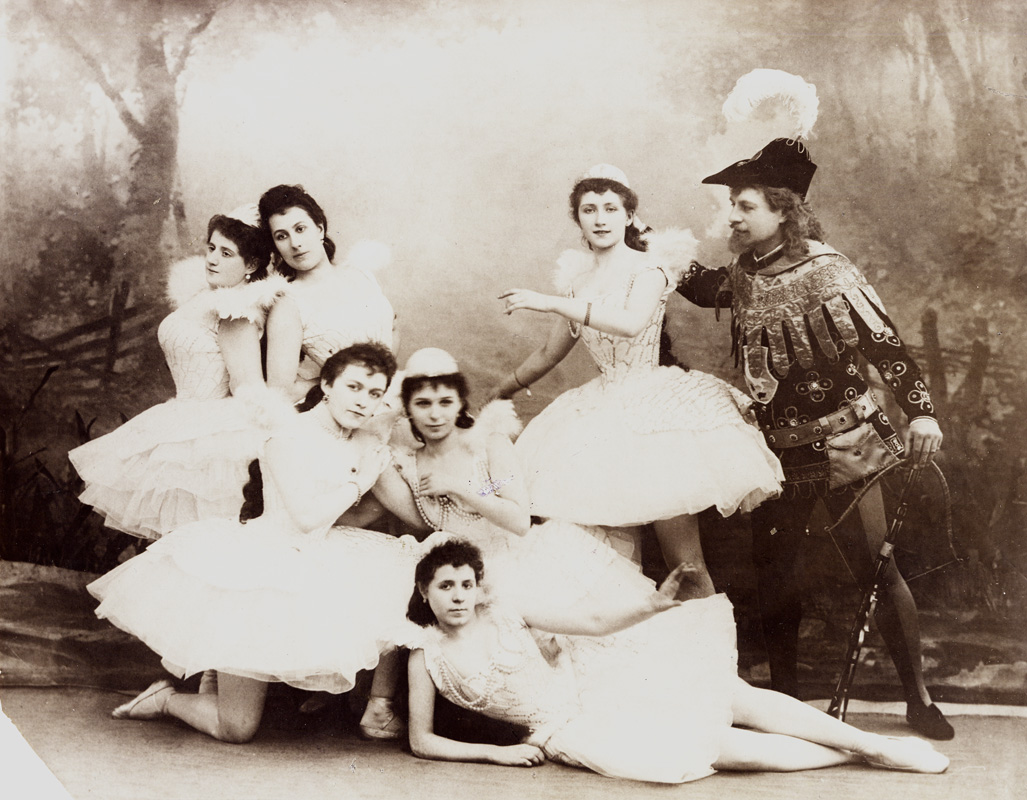
Swan Lake comes to Saint Petersburg
Three years after Swan Lake was withdrawn from the Moscow repertoire, Vsevolozhsky expressed interest in reviving one act of the ballet for the 1886-87 season in Saint Petersburg. Although this production was never materialised, Vsevolozhsky continued to show interest in Swan Lake and it was eventually agreed that Petipa would mount a new production of the ballet.
Tchaikovsky was delighted at the prospect of his first ballet being restaged by Petipa, of whom he held the greatest respect, proclaiming that “never with anyone but Petipa would I produce ballets.” However, just when plans to recreate Swan Lake were beginning to come into fruition, Tchaikovsky died on the 6th November [O.S. 25th October] 1893. In the aftermath, Riccardo Drigo was tasked with revising the score, but not before receiving approval from Modest Tchaikovsky, who now held the rights to his brother’s works. When work finally began on the new Swan Lake production, Petipa and Ivanov chose to collaborate on the ballet with Petipa staging Act 1, scene 1 and Act 2 (originally Act 1 and Act 3) and Ivanov staging Act 1, scene 2 and Act 3 (originally Act 2 and Act 4). They also divided the divertissements of Act 2 between them – Petipa choreographed the Spanish Dance and the Mazurka and Ivanov choreographed the Neapolitan Dance and the Czardas.
On the 17th and 22nd February 1894, Vsevolozhsky held a memorial concert for Tchaikovsky at the Mariinsky Theatre, in which the Imperial Ballet and Opera participated. The programme consisted of the first act of Tchaikovsky’s opera The Maid of Orleans, his Romeo and Juliet overture, the Coronation Cantana and the second scene of Swan Lake, as choreographed by Ivanov. This was the first presentation to the public of the new Swan Lake, with Pierina Legnani dancing the role of Odette.
Changes to the libretto
Modest Tchaikovsky was called upon to make the required changes to the libretto and the result was quite a different story from the original, but retained its key elements. The story was now more of a fairy tale rather than the Romantic story that Tchaikovsky had intended. Some of the characters listed in the 1877 programme were omitted, while the main characters underwent some transformations.
In the 1877 production, Odette is a supernatural creature – a swan maiden or a good fairy, which is what she is listed as in the 1877 programme. She’s also quite a cold character, as revealed by her reaction to Siegfried falling in love with her and promising to save her from her stepmother. For the 1895 production, Modest discarded the Romantic element of Odette being a swan maiden and took the fairy tale route of people cursed to turn into animals, making her a mortal princess who was abducted by an evil creature and placed under a spell that forces her to live away from society. Modest also omitted her complex backstory, all the references to her grandfather and the magic crown became just a crown that shows she is royalty.
Prince Siegfried became a more noble and heroic character than he was in 1877, where he was anything but a hero. In the original libretto, Siegfried is an arrogant, macho, idiotic simpleton, who is very easily led astray by the beautiful Odile, solely because of her beauty, even though she does not look like Odette and even after Benno says that he does not see the resemblance between the two. In the end, Siegfried becomes Odette’s murderer when he rips off her magic crown and throws it into the lake, even though he knew what that would do; he knowingly and selfishly endangers Odette by snatching away the one thing that protects her from harm and it kills her. In the 1895 libretto, he is a heroic, noble, and sympathetic fairy tale prince. He enjoys life and finds his royal duties boring and tiresome and would much rather have fun and go hunting, but what he really desires is true love. He undergoes a sudden growth to manhood when he falls in love with Odette: his desire for freedom from his royal duties no longer matter because now he has a new and more important mission – to rescue and marry the woman he loves from her evil imprisonment. Modest also changed the nature of Siegfried’s betrayal so that he is now an innocent victim of a terrible deception because he genuinely believes Odile to be Odette as the Evil Genie has used magic to make her look like the Swan Queen, giving Siegfried a good reason to fall for the trickery.
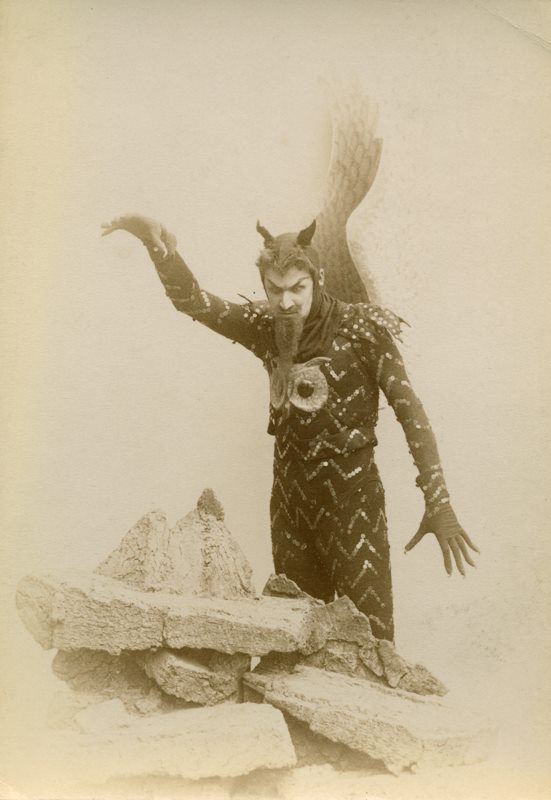
The evil stepmother was omitted and Von Rothbart was upgraded to the story’s villain, becoming the Evil Genie, an evil of the forest who assumes the form of a gigantic owl. It is only the second act that he is known as Von Rothbart when he appears at the ball disguised as a knight. The Evil Genie’s role was made into a dangerous creature of the forest who abducts mortal girls and women, and enchants, quite a typical troupe of male supernatural creatures. He bears some similarities to the Erlking, a sinister elf from German Romanticism, who lives in the woods or forest and kills children who either stay in the woods too long or have gotten lost with a single touch.
The vow of eternal love and fidelity as the only weapon to break the spell was retained and the purpose for the trickery against Prince Siegfried was no longer to condemn Odette to death, but to forever remain a swan and under the Evil Genie’s power. The most significant change was the ending; rather than Siegfried and Odette simply drowning in the lake, Modest altered the ending so that the lovers commit suicide together rather than live without each other, which not only breaks the spell, but causes the downfall of the Evil Genie. An apotheosis shows Siegfried and Odette forever united in the afterlife; true love has won and evil has been defeated.
1895 Libretto
The first scene of Act 1 takes place in a park outside Prince Siegfried’s castle, where the Prince is celebrating his 21st birthday with his friends and peasants, including his best friend Benno and his tutor Wolfgang. However, in the midst of the celebrations, Siegfried’s mother the Queen arrives unannounced and protests the merry-making, reminding her son of his duties. Now that he has come of age, he will be king soon and must marry. A ball will be held at the castle the following evening and the Queen reminds Siegfried that he is choose a bride from the eligible maidens attending. Siegfried is uneasy at the thought of parting with his bachelor life and the joys that come with it, but his mother is adamant on the matter. After she departs, the celebrations continue and Wolfgang, who is now drunk, attempts to join in the dancing by dancing with one of the girls, but she teases him and sends him spinning to the ground. When the celebrations have ended, the peasants depart and Siegfried suggests to Benno and their friends that they end the evening with a hunt. Benno has just caught sight of a flock of swans flying into the forest, so, armed with crossbows, the hunting party sets off.
The second scene takes place at an enchanted lake by the ruins of an old chapel deep in the forest. The swans are swimming on the lake and leading them is one wearing a crown. Siegfried, Benno and the hunters arrive in a clearing by the lakeside. Siegfried sends the others to search for the swans, when the crowned one appears by the shore and he prepares to shoot it, but before he can, the swan transforms into Princess Odette. She is terrified when she sees Siegfried, but he lays down his crossbow and promises he will not harm her. When he asks for her story, she explains that she and her friends have been enchanted by an evil genie in a spell that leaves them women by night and swans by day. The lake where they live was formed by the tears of Odette’s grieving mother and the spell can only be broken by a vow of eternal love and fidelity to Odette from one who has never loved before. The Evil Genie appears in the guise of an owl and Siegfried attempts to kill him, but Odette intercede: the genie’s death would only make the spell permanent. Odette’s friends, the Swan Maidens, and Siegfried intervenes in time to stop Benno and the hunters from killing them. As the night passes by, they all dance together by the lake and Siegfried and Odette fall in love, and he swears to love and marry her. Dawn approaches and the Evil Genie returns as Odette and her friends are forced back onto the lake as swans.
The second act takes place in the ballroom of Siegfried’s castle, where the ball is underway. Siegfried arrives with his mother and she introduces six princesses, one of whom he must choose to marry. Siegfried dances with the princesses, but rejects them all, remembering his vow to Odette. The Master of Ceremonies announces the arrival of two uninvited guests – the knight Von Rothbart, who is really the Evil Genie in disguise, and his daughter Odile, who he has magically disguised as Odette. Siegfried falls for the trickery and dances with Odile, failing to notice the real Odette in her swan form at the window, trying in vain to warn him that he is being deceived. Afterwards, Siegfried chooses Odile as his bride and, believing her to be Odette, swears eternal love and fidelity to her. With this, the Evil Genie and Odile burst out laughing in triumph, revealing their true identities, and Siegfried finally sees Odette at the window, but it is too late. Distraught, he flees from the castle in search of her.
The third act takes place back at the lake, where the Swan Maidens await Odette’s arrival. She rushes in and tearfully tells them about Siegfried’s betrayal and that she yearns for death, the only thing that can now free her. The Swan Maidens take her into their midst and comfort her, until Siegfried arrives and finds her among her friends. He falls to his knees, begging her forgiveness, and she tenderly forgives him, but the Evil Genie arrives and taunts them by reminding Siegfried of his vow to Odile. Siegfried refuses to comply and Odette runs to his side, driving the Evil Genie off and declares, despite Siegfried’s pleadings, that she will escape the spell through death. Fleeing from his arms, Odette throws herself into the lake and Siegfried follows her. The Evil Genie falls down dead, the spell is broken and, as the sun rises, Siegfried and Odette are seen together in a swan-drawn boat, sailing into the afterlife.
World Première
The Petipa/Ivanov recreation of Swan Lake was premièred on the 27th January [O.S. 15th January] 1895 starring Pierina Legnani as Odette/Odile and Pavel Gerdt as Prince Siegfried. The ballet received a mixed, but better reception than the 1877 production with Legnani enchanting the audience in the dual role of Odette/Odile.
Petipa and Ivanov’s Swan Lake was notated between 1901 and 1907 in the Stepanov notation method and is part of the Sergeyev Collection.
Swan Lake in the 20th Century
The first revival of Petipa and Ivanov’s Swan Lake was staged by Alexander Gorsky for the Imperial Bolshoi Ballet in 1901. A famous change made by Gorsky was the addition of a court-jester to the first and second acts, which was later retained in Soviet productions of Swan Lake. Among the earliest presentations of the ballet in the west was when a troupe of dancers from the Imperial Ballet led by Anna Pavlova and Nikolai Legat performed in Swan Lake across Scandinavia and Germany in their 1908-1909 tour of the west. In 1910, at the beginning of her tours of Britain with her company, Pavlova added the neglected Danse Russe to her repertoire as a duet choreographed by her dance partner Mikhail Mordkin, Pavlova and Mordkin famously danced this duet around Britain, always dressed in traditional Russian-style costumes. After Mordkin’s departure from her company, Pavlova continued to perform the number as a solo.
Swan Lake made its London première in 1910 when it was staged at the Hippodrome Theatre by another group of dancers from the Imperial Ballet led by Olga Preobrazhenskaya. A year later, on the 30th November 1911, Sergei Diaghilev staged a two-act production of Swan Lake for the Ballets Russes at the Royal Opera House, Covent Garden, with Matilda Kschessinskaya as Odette/Odile and Vaslav Nijinsky as Prince Siegfried. Another notable early 20th century production was Bronislava Nijinska’s 1919 production for the State Opera Theatre in Kiev. Diaghilev staged his two-act production again in Monte-Carlo in 1924, with Vera Trefilova, who was nearly 50 years old at the time, as Odette/Odile. In 1941, Nikolai Sergeyev staged the second scene from his notation scores for the première performance of Mona Inglesby’s International Ballet, which took place on the 19th May 1941 at the Alhambra Theatre in Glasgow. In 1947, Sergeyev and Inglesby staged the full length ballet with the former’s notation scores for International Ballet and the production premièred in March 1947 at the Adelphi Theatre, London.
Throughout the 20th century, Petipa and Ivanov’s Swan Lake has been staged in countless revivals all over the world. The most famous of modern productions include Dame Ninette De Valois’s various productions and Sir Anthony’s Dowell’s 1987 production for the Royal Ballet, George Balanchine’s 1951 one-act staging for New York City Ballet, Konstantin Sergeyev’s 1950 production for the Kirov/Mariinsky Ballet, Yuri Grigorovich’s production for the Bolshoi Ballet, which was revived in 2001, and Rudolf Nureyev’s production, staged for the Vienna Staatsoper Ballet in 1964 and for the Paris Opera Ballet in 1984. Perhaps the most distinguishable feature about various modern productions is the usage of different endings, with some productions using tragic endings where either Siegfried and Odette or one or the other die and others using happy endings, in which Rothbart is vanquished and Siegfried and Odette are reunited to live happily ever after.
In February 2016, Alexei Ratmansky mounted a reconstruction of Petipa and Ivanov’s Swan Lake for the Zürich National Ballet. The reconstruction had its world première at the Zürich Opera House on the 4th February 2016, with Viktorina Kapitonova as Odette/Odile, Alexander Jones as Prince Siegfried, Manuel Renard as the Evil Genie/Von Rothbart and Andrei Cozlac as Benno. Months later, Ratmansky staged his reconstruction at the Teatro alla Scala for the La Scala Ballet, where it premièred on the 30th June 2016, with Nicoletta Manni as Odette/Odile, Timofei Andrijashenko as Prince Siegfried, Mick Zeni as the Evil Genie/Von Rothbart and Christian Fagetti as Benno.
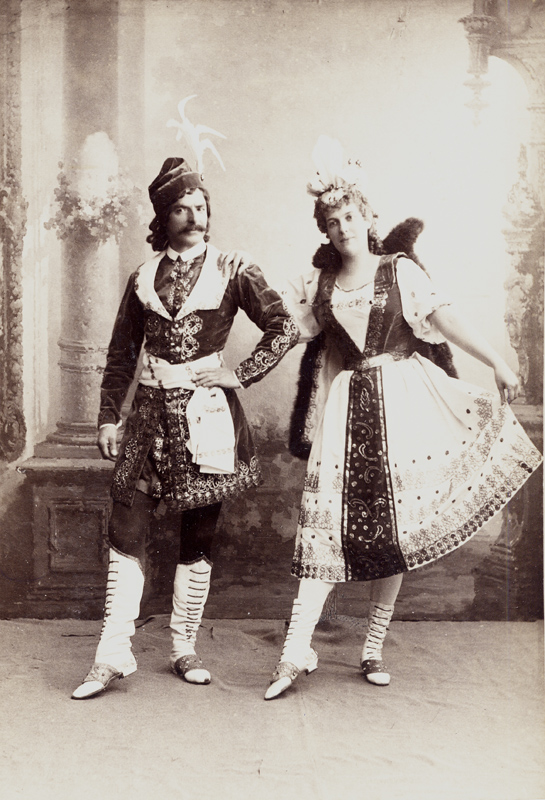
Grand Pas d’action
The Grand Pas d’action of Act 1, scene 2 was originally choreographed by Lev Ivanov as a pas de deux à trois, in which Odette was partnered by both Prince Siegfried and Benno. Contrary to popular belief, the decision by Ivanov to include Benno in the pas d’action had nothing to do with Pavel Gerdt’s age (he was 50 years old at the time), for even at 50, Gerdt was still a strong and popular partner, who could easily partner the women without assistance from younger dancers. It was when Nikolai Legat succeeded Pavel Gerdt in the role of Prince Siegfried between the late 1890s and early 1900s that the lakeside pas d’action became a pas de deux as Legat chose to partner Odette alone and other danseurs would follow his example. The group of hunters, who accompanied Siegfried and Benno to the lake, also took part in the pas d’action, standing at the sides of the stage with the Swan Maidens.
Ivanov’s original Pas de deux à trois scheme was used in early to mid 20th century productions, with one example being several of Dame Ninette De Valois’s productions for the Sadler’s Wells Royal Ballet. In 1960, the second scene of this production was filmed with the pas de deux à trois performed by Dame Margot Fonteyn as Odette, Michael Somes as Prince Siegfried and Bryan Ashbridge as Benno. This was to be one of the final productions to stage Ivanov’s pas de deux à trois as it disappeared from Swan Lake thereafter and was replaced with the revived pas de deux for Odette and Siegfried. It was not until Alexei Ratmansky’s 2016 reconstruction that the pas de deux à trois reappeared on the ballet stage, circa. fifty years after its previous appearance.
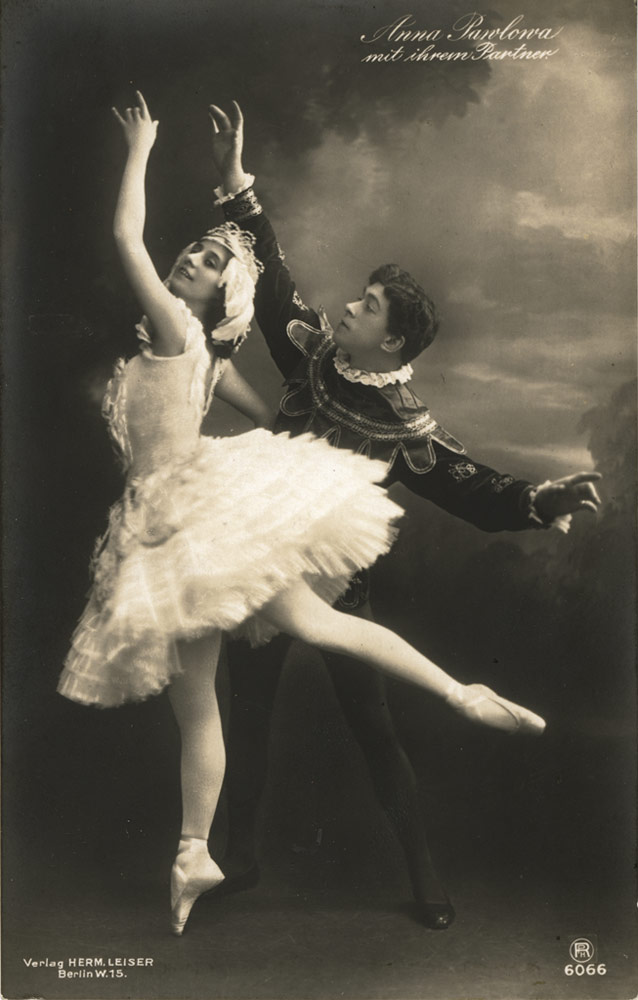
Grand Pas de deux
The Grand Pas de deux of the second act has a very complex history. It is widely known today as the “Black Swan Pas de deux”, but it was never staged under any such title by Petipa.
One of the most interesting facts about the 1895 production of Swan Lake is that the character Odile was not a “Black Swan” – she was simply Von Rothbart’s daughter, an evil enchantress. Pierina Legnani did not wear a black costume as Odile, but a royal blue costume with striking, multi-coloured glittered designs with no feathers or swan designs. Other productions of Swan Lake in Russia used similar costume designs for Odile during the late 19th century and early 20th century. According to a 1901 review of the Petipa/Ivanov Swan Lake production, Matilda Kschessinskaya, Legnani’s successor in the role of Odette/Odile, wore “an elegant black dress” in the second act, but there is no mention of the dress having any feathers or swan designs.
The first time Odile appeared as “the Black Swan” in a 1920 revival of Alexander Gorsky’s 1901 production staged by Vladimir Nemirovich-Danchanko at the Bolshoi Theatre. In the west, the tradition spread after a 1941production staged by Alexandra Feodorova-Fokine for the Ballet Russe de Monte Carlo at the Metropolitan Opera House in New York City. This production was staged under the title, The Magic Swan and starred Tamara Toumanova as Odette/Odile. At the time, the only part of Swan Lake that was known in the west was the famous second scene and in an effort to have the audience distinguish Odile from the well-known Odette, Fedorova-Fokine had Toumanova dance Odile in a black costume and almost by accident, Odile began to be referred to as “the Black Swan” and it was this 1941 production that seems to have set the tradition in motion in the west. In Alexei Ratmansky’s reconstruction of Petipa and Ivanov’s Swan Lake, Odile wears a multi-coloured, glittered costume, based on the costume worn by Pierina Legnani in 1895, as designed by French designer Jérôme Kaplan.
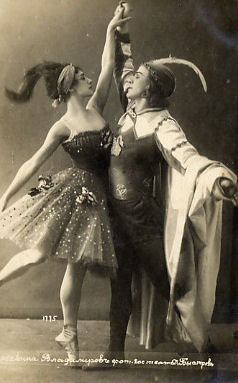
The Grand Pas de deux was originally composed by Tchaikovsky as a Pas de deux for Two Merry Makers in Act 1. It became the ballet’s Grand Pas de deux when Petipa transferred it to Act 2 and Drigo extensively revised the music, adding a new ending to the Grand Adagio and an interpolation from Tchaikovsky’s Opus 72 for Piano as the Variation of Odile. Petipa originally choreographed this pas as a Pas de deux à quatre demi d’action; it was performed by Pierina Legnani, who was partnered by both Pavel Gerdt and an additional cavalier, who was danced by Alexander Gorsky, and Alexei Bulgakov, who danced Von Rothbart, performed most of the mime. In Petipa’s original Grand Pas de deux, there are no swan movements for Odile. This is because rather than imitating Odette’s movements, Odile shows her skills as an enchantress by using her magic to enchant Siegfried. This is especially noticable when the vision of Odette appears at the window and Odile covers Siegfried’s eyes to prevent him from seeing the vision.
After the Grand Adagio, Pavel Gerdt did not dance a variation, but Alexander Gorsky did. The original Variation of Prince Siegfried was choreographed to the Tempo di valse piece that Tchaikovsky originally composed for this pas de deux. Alexander Gorsky notated the Variation of Prince Siegfried in 1899, though it is not known for sure if this is the same variation he danced in the 1895 première. However, it is very likely that he choreographed his own variation since, at the time, it was very common for the male dancers to choreograph their own variations. The famous traditional Variation of Prince Siegfried that is danced by nearly every ballet company today has been credited to Vakhtang Chabukiani. The music for this variation was fashioned from Tchaikovsky’s original allegro ending for solo violin for the Grand Adagio, which was cut from the score for the 1895 production. It has been said that Chabukiani was the first to perform this variation in the 1940s.
The biggest sensation of the Grand Pas de deux was, of course, the famous 32 fouettés en tournant, which Pierina Legnani was the first ballerina to perform on the Russian stage. Other ballerinas had performed fouettés in various works on the Russian stage before, for example, the ballerina, Emma Bessone had performed 14 fouettés in Ivanov’s three-act ballet The Haarlem Tulip. Legnani, however, set a new record when she introduced 32 of them in Ivanov and Enrico Cecchetti’s 1893 production of Cinderella. According to Alexander Shiryaev, Legnani performed “arabesque fouettés”, as he called them, meaning she performed them en dedans, rather than en dehors as they are performed today. Matilda Kschessinskaya would later become the first Russian ballerina to successfully perform the 32 fouettés after she succeeded Legnani in the role of Odette/Odile, but they were not accepted by every ballerina. Olga Preobrazhenskaya apparently detested the 32 fouettés because she considered them to be a “vulgar trick”. When she inherited the role of Odette/Odile, instead of the 32 fouettés, Preobrazhenskaya performed a manege of turns in the Grand Pas de deux coda.
The idea of replacing a sequence of fouettés with a manege of turns was later used by other ballerinas. One prime example of a ballerina who followed Preobrazhenskaya’s example on this matter was the great Bolshoi Prima Ballerina Maya Plisetskaya. Although Plisetskaya performed fouettés in other ballets, she rarely performed the 32 fouettés in Swan Lake. During a tour of the United States with the Bolshoi Ballet, she was slighted by the press when they suggested that she could not do them, so in her next performance of Swan Lake, Plisetskaya took revenge and executed a faultless 32 fouetté sequence.
Related pages
References
- Tchaikovsky in a letter to his brother, Modeste, dated 5th October 1870, quoted in Tchaikovsky’s Ballets: Swan Lake, Sleeping Beauty, The Nutcracker, pg. 31 ↩︎
- Memoirs about P.I. Tchaikovsky (p. 26), quoted in Tchaikovsky’s Ballets: Swan Lake, Sleeping Beauty, The Nutcracker, pg.38 ↩︎
- Chaikovskii i baletnyi teatr (p. 89), quoted in Tchaikovsky’s Ballets: Swan Lake, Sleeping Beauty, The Nutcracker, pg. 38 ↩︎
- Moskovskie vedomosti, 15th January 1880 (p. 4), quoted in Tchaikovsky’s Ballets: Swan Lake, Sleeping Beauty, The Nutcracker ↩︎
Sources
- Cyril Beaumont (1952) The Ballet Called Swan Lake. London, UK: Dance Books Ltd
- Lynn Garafola (1989) Diaghilev’s Ballets Russes. USA: 1998 ed. Da Capro Press, Inc.
- Mona Inglesby and Kay Hunter (2008) Ballet in the Blitz: the History of a Ballet Company. Debenham, Suffolk, England, UK: Groundnut Publishing
- Roland John Wiley (1985) Tchaikovsky’s Ballets: Swan Lake, Sleeping Beauty, The Nutcracker. Oxford, UK: Clarendon Press
- Roland John Wiley (1997) The Life and Ballets of Lev Ivanov. Oxford, UK: Clarendon Press
Photos and images: © Dansmuseet, Stockholm © Большой театр России © Victoria and Albert Museum, London © Государственный академический Мариинский театр © CNCS/Pascal François © Bibliothèque nationale de France © Musée l’Opéra © Colette Masson/Roger-Viollet © АРБ имени А. Я. Вагановой © Михаил Логвинов © Михайловский театр, фотограф Стас Левшин. Партнёры проекта: СПбГБУК «Санкт-Петербургская государственная Театральная библиотека». ФГБОУВО «Академия русского балета имени А. Я. Вагановой» СПбГБУК «Михайловский театр». Михаил Логвинов, фотограф. Martine Kahane.
 The Marius Petipa Society