
Ballet divertissement
Music by Cesare Pugni
Choreography by Jules Perrot
World Première
12th July 1845
Her Majesty’s Theatre, London
Original 1845 Cast
Marie Taglioni
Fanny Cerrito
Carlotta Grisi
Lucile Grahn
History
The original version
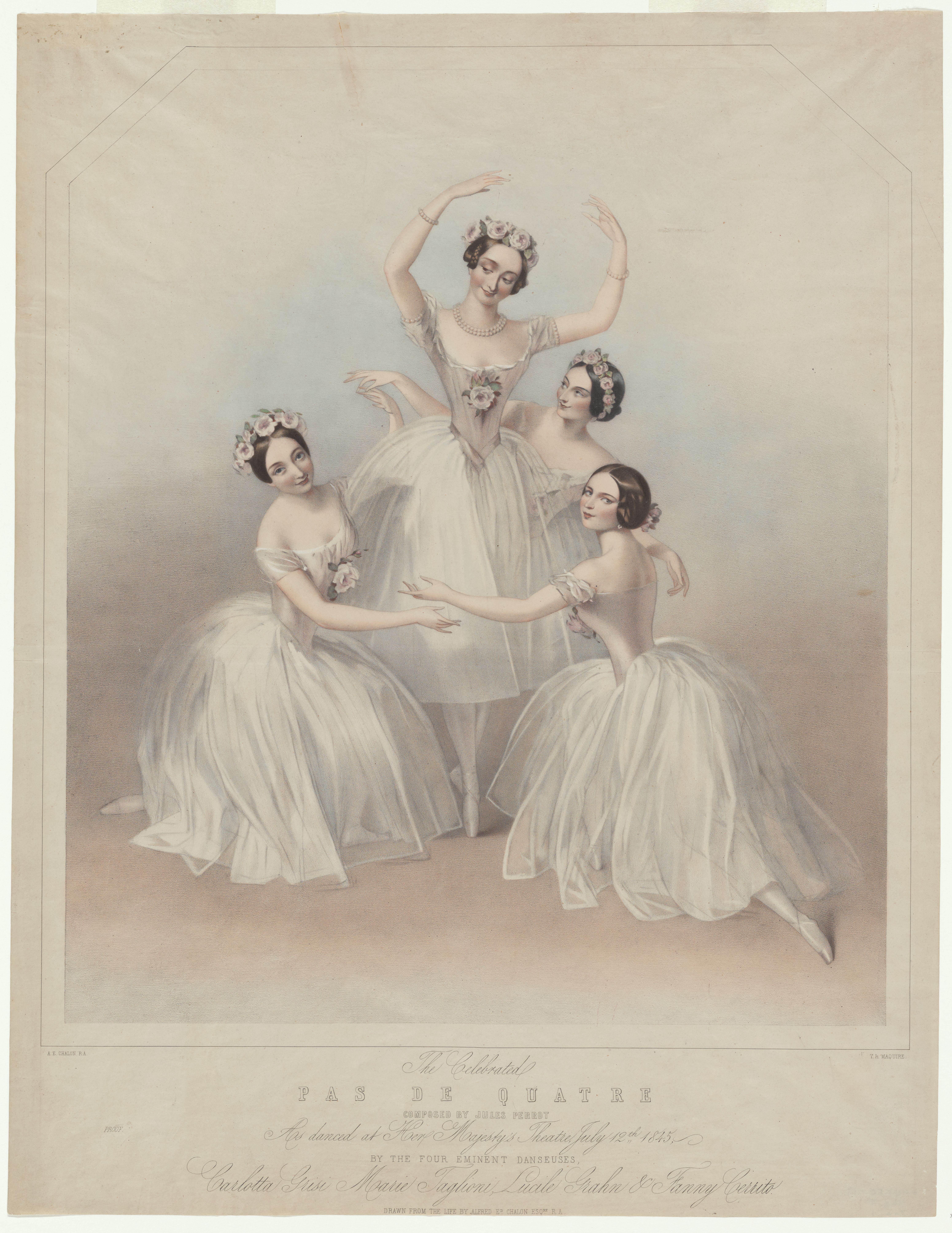
The Pas de Quatre is a ballet divertissement created by Jules Perrot and Cesare Pugni for four of the greatest ballerinas of the 19th century. The Romantic Ballet was dominated by five ballerinas, who were deemed the epitome of the era – Marie Taglioni, Lucile Grahn, Fanny Elssler, Carlotta Grisi and Fanny Cerrito. On several occasions, there were attempts to bring these dancing goddesses together on stage, but not all were successful. In 1841, during Pierre Laporte’s last year as Director of Her Majesty’s Theatre in London, a new grand ballet entitled Le Jugement de Pâris in which Taglioni, Elssler and Cerrito would star was announced but not produced1. Two years later in 1843, Laporte’s successor Benjamin Lumley succeeded in persuading Cerrito and Elssler to appear together in a pas de deux that was very successful. The fact that he was able to bring such a pas into fruition was considered something of a miracle. Nevertheless, the experience deepened Lumley’s ambitions to create a bigger work for the three aforementioned dancers to appear in.
In 1845, Lucile Grahn made her début in London, and there was further excitement when it was realised that Taglioni, Cerrito and Carlotta Grisi would all be in the English capital at the same time. Elssler was engaged elsewhere. Lumley jumped at the chance to engage the three ballerinas for a new ballet in which they would appear together and in February, The Times announced that they might ‘appear in one single ballet – a collision that the most carelessly managed railroad could hardly hope to equal.’2 The Morning Chronicle disclosed that the new work had intended to be a mythological ballet, possibly referring to the original, unproduced idea of Laporte from 1841, but Perrot had been advised to produce a pas de trois with no introductory narrative. Following the success of her London début, Grahn was also invited to be part of the new work, thereby transforming the pas de trois idea into a pas de quatre. Lumley, however, was aware of the risks behind such an ambitious project, not in the least due to the rivalries between the dancers, so persuading them to appear together required a good bit of coaxing, flattery, and supplication. Lumley clearly succeeded in gaining the ballerinas’ cooperation, but this was only the first step as the most challenging of tasks lay in devising the choreography, which he entrusted to Perrot with the following instructions:
“Every twinkle of each foot in every pas had to be nicely weighed in the balance, so as to give no preponderance. Each danseuse was to shine in her peculiar style and grace to the last stretch of perfection; but no one is to outshine the others – unless in their own individual belief.”3
Pugni, who was commissioned as composer, was no doubt given the same instructions for the music. The key was for the Pas de Quatre to showcase each ballerina’s skills and levels of greatness as equals and individuals, not as a competition to determine who was the greatest.
Perrot’s choreography
Perrot’s choreography has not survived, but Ivor Guest offers a good description and insight of the ballet’s structure and choreography in several of his books, including Jules Perrot: Master of the Romantic Ballet, bringing together descriptions from different eyewitness accounts.
“The ballet began with an introduction of elegant, picturesque groups. Taglioni was always in the centre of these groups with the others positioned around and above her, their arms outstretched as if in homage. These groups were succeeded by a ‘quick transverse movement’, followed by a brilliant solo for Grahn and then, a pas de deux for Cerrito and Grisi that was succeeded by Taglioni performing a series of jétés across the stage.
The first variation was an allegro variation for Grahn, revolving with ‘dainty semi-circular hops’ en pointe as light as ‘a feather in a current of wind’ yet vigorous, and in her poses, astonishingly firm. The second variation was an andante movement for Grisi, performing ‘tip-toe flights’ and ‘lightning gyrations’ of ‘equal dexterity and number, mingled, however, with a world of little sprightly steps, which multiplied her feet into thousands – a piquant, coquettish variation in which she brought her youthful grace and fascination into full play. A romantic note was now struck, as the tempo changed to slow, expressive andantino movement danced by Taglioni and Grahn. But this mood was only momentary. Cerrito, who had been calmly contemplating her rivals from the back of the stage, burst into action with a rapid sequence of turns, taken diagonally across the stage, followed by some jétés so buoyant that, the words of one spectator, ‘you could see she would have striven to “put a girdle around the earth in forty minutes”’… It was now the turn of the supreme ballerina, herself, and it was a tribute to her artistry that, in spite of the triumphs that had gone before, she could raise the enthusiasm to new heights. Hers was an allegro variation, gentle and languid in mood, in which she ‘displayed all her commanding manner, relying much on that advancing step of which, we believe, she was the inventress, and astonishing by some of her bounds.’ In it she introduced ‘steps with the knee bent forward’ which were so completely her own that no other dancer had succeeded in imitating them, and it was observed that her ‘line of dancing was always maintained nearer the perpendicular’ than that of her companions.
Then came the coda, in which all four vied with one another in performing ‘steps of various and dazzling complexity,’ ‘flying with a rapidity the eye could scarcely follow, mingled in beautiful evolutions and presenting a moving picture of which no description can give any idea,’ and finally coming together with precision to form a ‘sculpturesque’ group.”4
World Première
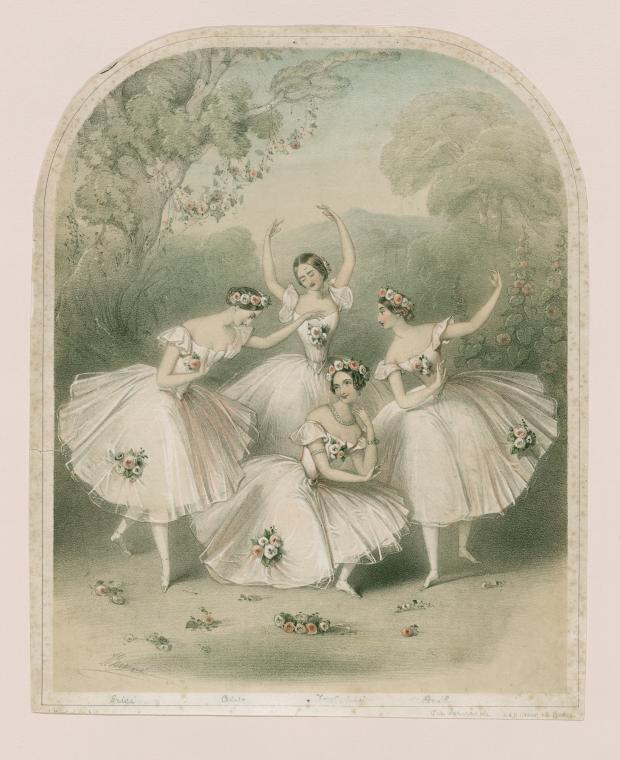
Preparations for the historic performance that was scheduled for the 12th July 1845 were soon underway and everything was going according to plan, until the morning of the première when an incident occurred that almost threatened the whole event. An argument broke out between Cerrito and Grisi over precedence. While neither ballerina questioned Taglioni’s right to dance the final variation, they both claimed precedence for second place. According to Taglioni, it was Cerrito who started the quarrel and Grisi flew into a great rage, stamping about the stage and called her colleague “a little chit”. In despair, Perrot rushed to Lumley’s office, reported the incident and Lumley’s solution was, in Guest’s words, ‘worthy of Solomon’. He said, “The question of talent must be decided by the public, but in this dilemma, there is one point on which I am sure the ladies will be frank. Let the oldest take her unquestionable right to the envied position.”5
The effect miraculously worked, and the incident was settled, about which Lumley wrote in his memoirs:
‘The ballet-master smote his forehead, smiled assent, and bounded from the room upon the stage. The judgement of the manager was announced. The ladies tittered, laughed, drew back, and were now as much disinclined to accept the right of position as they had been before eager to claim it. The ruse succeeded. The management of affairs was left in Monsieur Perrot’s hands. The order of the ladies being settled, the grand pas de quatre was finally performed on the same night before a delighted audience, who little knew how nearly they had been deprived of their expected treat.”6
However, when evening came and the performance was to begin, there were some in the audience who doubted that the mission to bring the four great ballerinas together had been fulfilled. But when the lights darkened and the orchestra began to play, all doubts vanished when the curtain rose and Taglioni, Cerrito, Grisi and Grahn, all clad in pink and adorned by roses in their hair, walked on stage holding hands and curtseyed. The auditorium erupted in thunderous applause. The ballet and the event were an outstanding success: Lumley had achieved what many had believed to be impossible, and Perrot’s choreography showcased the four great ballerinas of the Romantic Era in all their glory. The critics were enchanted to the bone as proven by the reviews. The Vicomtesse de Malleville wrote in the Le Courrier de l’Europe wrote, ‘There are more than ten ballets of the calibre of ‘La Esmeralda’ in this new effort of Perrot.’7 The critic of The Times wrote, ‘Never was such a pas before, it was the greatest Terpsichorean exhibition that ever was known in Europe.’8 According to the Era, ‘[The Pas de Quatre] shook one’s soul to the very centre’9 and the Morning Herald concluded that it marked ‘an era in the records of the ballet-master’s art, and those who saw it chuckle to this day with satisfaction, and talk boastingly to those who did not.’10
The Pas de Quatre was performed only four times in total with the original cast. After the première, it was given three more performances on the 15th, the 17th, and the 19th July before Grisi left London. The third performance on the 17th July was attended by Queen Victoria and Prince Albert. The ballet was revived two years later in 1847 for two performances on the 17th and 20th July, with Carolina Rosati dancing Lucile Grahn’s role.
Subsequent stagings
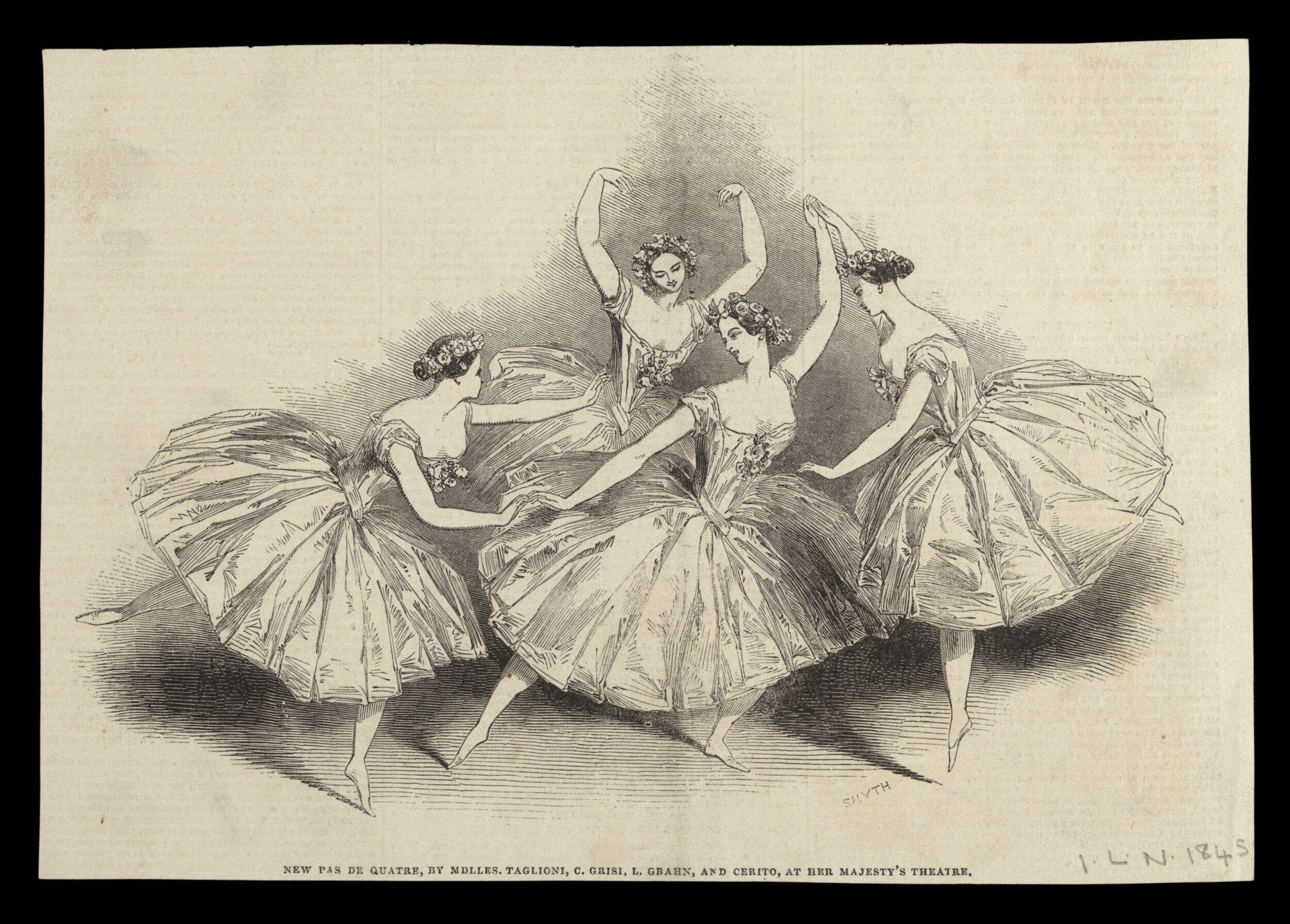
Less than a year later, the Pas de Quatre was staged abroad for the first time by Filippo Taglioni when Marie Taglioni was appearing at the Teatro alla Scala in Milan. The ballet received its La Scala première on the 14th March 1846, starring Marie Taglioni, Carolina Rosati, Sofia Fuoco and Carolina Vente (aka Karolina Wendt, the great Polish ballerina). Polish dancer and historian, Adam Huczka writes that Marie probably taught Perrot’s choreography to her new partners, rather than her father, who accompanied her to Milan, but what is certain is that Filippo Taglioni added a new duet for Marie and the Italian dancer Margherita Wuthier and twelve students from the La Scala School.11
At the time, Filippo Taglioni was Ballet Director of the Teatr Wielki and the ballet school in Warsaw, Poland and he would bring the Pas de Quatre there in 1847, the year it was last performed in London. The Pas de Quatre was given its Polish première on the 12th October 1847 at the Orangery Theatre in the grounds of the Royal Łazienki, which, at the time, served as the primary Warsaw residence of the Russian monarchs, with Tsarevich Alexander Romanov (the future Tsar Alexander II of Russia) among the distinguished guests in attendance. Nine days later, Taglioni staged the ballet at the Teatr Wielki (the Warsaw Grand Opera House) on the 21st October. The starring ballerinas were Konstancja Turczynowicz, Teodora Gwozdecka, Paulina Straus and Anna Piechowicz. The last mention of a performance of the Pas de Quatre was at the Orangery Theatre on the 6th October 1850 and this seems to have been its last performance in the 19th century. Perrot’s choreography did not survive and by the turn of the 20th century, the Pas de Quatre had fallen into the annals of ballet history and legends.
The Pas de Quatre in the 20th Century
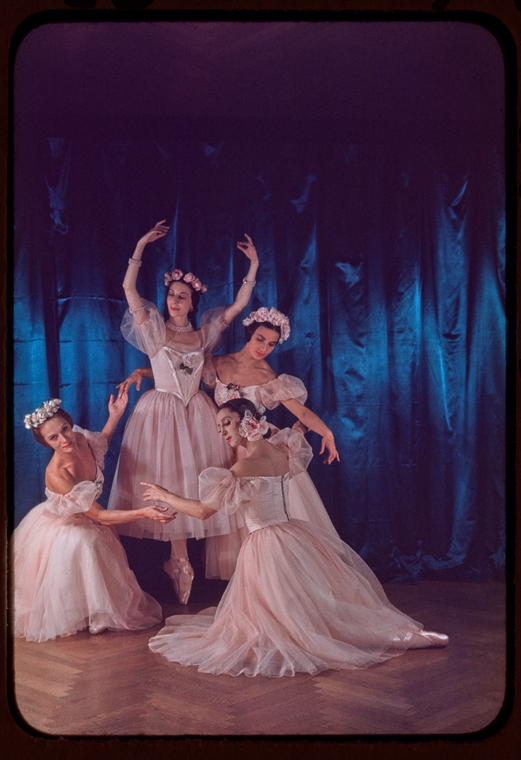
In 1936, British ballet dancer and choreographer Keith Lester created a new revival of the Pas de Quatre for the Dolin-Markova Ballet. This occurred after the piano reduction of Pugni’s score was discovered in the British Museum by British historian Cyril Beaumont, who shared it with Lester, Alicia Markova and Anton Dolin. Lester was commissioned to revive the lost ballet and he did so by studying the lithographs of Alfred Edward Chalon, John Bernard and others (see fig. 1 and 2), and accounts and reviews from eyewitnesses of the 1845 première. The music was orchestrated and arranged by Leighton Lucas, though the original orchestrations by Pugni were later discovered in Paris in the 1970s. Lester’s recreation of the Pas de Quatre premièred in 1936 at the Lyric Hammersmith in London.
In 1940, co-founder of Ballet Theatre (now, American Ballet Theatre), Lucia Chase requested for Lester’s Pas de Quatre to be staged for her company. Dolin, who had joined the company, sent word to Lester, asking him to send his notes and Lester agreed. However, Dolin claimed the notes never arrived, so he took it upon himself to stage the Pas de Quatre. This was a controversial matter because Dolin never credited Lester, who told his associates and students that Dolin’s staging was a “straightforward pinch” of his choreography. Dolin’s version was premièred on the 16th July 1941 at the Majestic Theatre in New York, starring Nana Gollner, Alicia Alonso, Nathalie Krassovska and Mia Slavenska. While this was a clear case of plagiarism, Lester never sued Dolin or made a public accusation against him, primarily because copyright in ballets did not exist at the time, which would have made it too troublesome. Instead, Lester let the matter go and Dolin’s version has since been staged all over the world and has been danced by some of the great ballerinas of the 20th century, besides the 1941 cast, including Alicia Markova, Alexandra Danilova, Carla Fracci, Eva Evdokimova and Ghislaine Thesmar.
In 1948, Alicia Alonso, one of the original 1941 cast members, staged the Pas de Quatre for the Nacional Ballet de Cuba. Alonso credited both Lester and Dolin for this version, claiming it was based on both versions. Alonso revived her Pas de Quatre in 1966 and subsequently staged it abroad: first for the Paris Opera Ballet in 1973 and then for the Polish National Ballet in 1980. Lester’s version was claimed to have been staged for the National Dance Company in Mexico, first in 1953 by Felipe Segura and in 1966 by ABT Ballet Master Michael Land. Lester, himself, taught his Pas de Quatre to his students at the Royal Academy of Dance, where he was teacher from 1961-1975 and it was notated by Michelle Groves and Dr Ann Hutchinson-Guest in Labanotation.

References
- Le Jugement de Pâris would be produced six years later in 1847, starring Taglioni, Grahn, Cerrito and Arthur Saint-Léon ↩︎
- Quoted in Jules Perrot: Master of the Romantic Ballet by Ivor Guest, p. 150 ↩︎
- Quoted in Jules Perrot: Master of the Romantic Ballet by Ivor Guest, p. 150 ↩︎
- Ivor Guest, Jules Perrot: Master of the Romantic Ballet, p. 151-152 ↩︎
- Quoted in The Romantic Ballet in England by Ivor Guest, p. 110 ↩︎
- Quoted in The Romantic Ballet in England Ivor Guest, p. 110 ↩︎
- Le Courrier de l’Europe, 19th July 1845, quoted in The Romantic Ballet in England by Ivor Guest, p. 112 ↩︎
- The Times, 14th July 1845, quoted in The Romantic Ballet in England by Ivor Guest, p. 112 ↩︎
- Era, 24th August 1845, quoted in The Romantic Ballet in England by Ivor Guest, p. 112 ↩︎
- Morning Herald, 20th August 1845, quoted in The Romantic Ballet in England by Ivor Guest, p. 112 ↩︎
- W ROCZNICĘ POWSTANIA “PAS DE QUATRE” PERROTA by Adam Huczka, published 12th July 2025: Teatr Wielki website ↩︎
Sources
- Ivor Guest (1954) The Romantic Ballet in England. Hampshire, UK: 2014 ed. Dance Books Ltd
- Ivor Guest (1985) Jules Perrot: Master of the Romantic Ballet. London, UK: Dance Books Ltd
- Dr Kathrina Farrugia-Kriel, New Steps, Old Steps: Retracing the legacy of Keith Lester (1904-1993). Royal Academy of Dance, London, UK
- Peter Brinson (1993) Obituary: Keith Lester. The Independent, 21st June 1993
- Teatr Wielki – Adam Huczka: W ROCZNICĘ POWSTANIA “PAS DE QUATRE” PERROTA
- Keith Lester: The resurrector of the Pas de Quatre by Amy Growcott – Substack: Dance & Write
 The Marius Petipa Society