
Romantic Ballet in three acts and five scenes
Music by Cesare Pugni
Libretto by Jules Perrot
Décor by Andrei Roller (Scenes 1, 3, 4 & 5) and Heinrich Wagner (Scenes 2 & 6)
World Première
22nd June 1843
Her Majesty’s Theatre, London
Choreography by Jules Perrot
Original 1843 Cast
Ondine
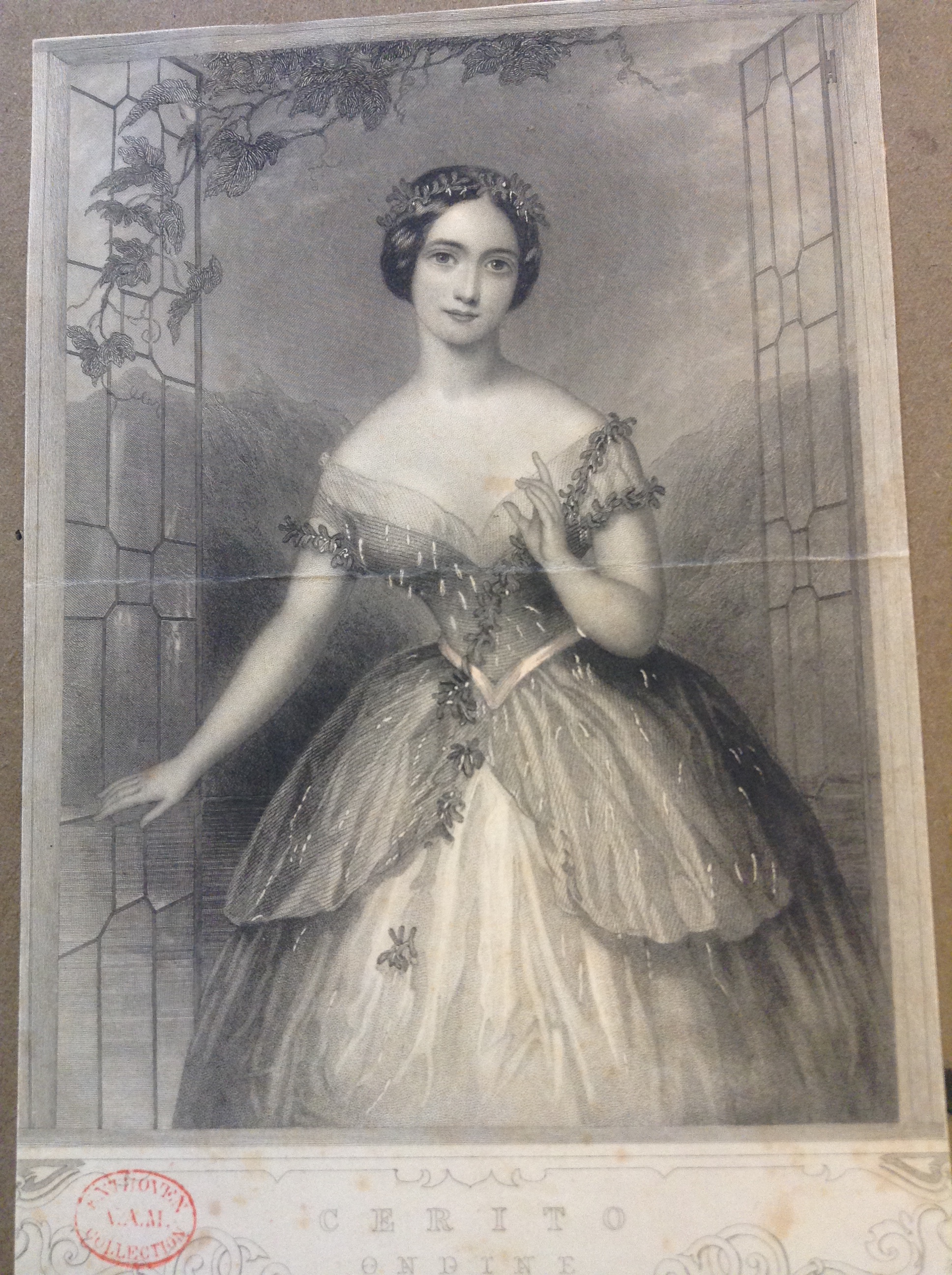
Fanny Cerrito
Matteo
Jules Perrot
Giannina
Marie Guy-Stéphan
Saint Petersburg Première
11th February [O.S. 30th Janaury] 1851
Imperial Bolshoi Kamenny Theatre
Original 1851 Cast
Ondine
Carlotta Grisi
Première of Petipa’s first revival
7th November [O.S. 27th October] 1874
Imperial Bolshoi Kamenny Theatre
Original 1874 Cast
Ondine
Eugenia Sokolova
Matteo
Pavel Gerdt
Giannina
Alexandra Kemmerer
Première of Petipa’s final revival
2nd October [O.S. 20th Septmber] 1892
Imperial Mariinsky Theatre
Original 1892 Cast
Ondine
Varvara Nikitina
Matteo
Pavel Gerdt
Giannina
Marie Petipa
History
The original production
Ondine, ou La Naïade was one of the many creations by Jules Perrot and Cesare Pugni. The creation of Ondine came after a turning point in Perrot’s career, which had been marked by a change in his personal life – the end of his off-stage relationship with his muse Carlotta Grisi in 1843. This turning point saw Perrot shifting the focus of his activity from Paris to London, where he had been invited as Ballet Master for a trial season the previous year by Benjamin Lumley, Director of Her Majesty’s Theatre. Lumley afforded Perrot opportunities to grow his genius skills as a choreographer, and Perrot would serve as Ballet Master of Her Majesty’s Theatre from 1843 to 1848.
The 1843 season would see Perrot create several new works for the London stage, especially for some of the finest ballet dancers who Lumley had also engaged for that season – Fanny Cerrito, Adèle Dumilâtre and Arthur Saint-Léon, with the latter two making their London débuts. But the most important turning point for Perrot occurred when he began to work with the composer who would become his lifelong collaborator – Cesare Pugni, who had just arrived in London from Paris. Pugni had gained experience in composing ballets in his native Italy at the Teatro alla Scala, where he had collaborated with the most celebrated choreographers working in Italy, including Gaetano Gioja and Louis Henry. However, due to precipitous circumstances, he had left Milan and had been living in obscurity and poverty in Paris for ten years until he was discovered either by Lumley or Perrot. Perrot and Pugni’s collaboration would produce some of the finest ballets of the Romantic Era and the first ballet score that Pugni composed for Perrot was that for La Esmeralda, which was intended to première in the 1843 season but was delayed until the following year. The first ballet they produced was a ballet divertissement called L’Aurore, which was created for Adèle Dumilâtre, the original Myrtha in Giselle, but during the première performance, Perrot sustained an injury, which prevented him from dancing for several weeks. Nevertheless, this gave him the opportunity to focus his imagination for the creation of a new ballet. Undoubtedly in collaboration with Lumley and Cerrito, Perrot and Pugni devised the idea for a new ballet that would be created as a vehicle for Cerrito entitled Ondine, ou La Naïade.
Cerrito was a favourite of the London audiences after she had previously enjoyed two successful appearances in the English capital in 1840 and 1842. She had first collaborated with Perrot during his trial season in 1842 when he created the ballet Alma for her. The 1842 season would be one of the highlights of Cerrito’s career with the creation of what would become her most famous role. Diving once again into the world of the supernatural, the story of Ondine was loosely based on Friedrich de la Motte Fouqué’s novella Undine, with some similarities to Hans Christian Andersen’s The Little Mermaid, for which Baron Fouqué’s novella was an inspiration.
Source of inspiration
Fouqué was inspired by the myths and legends of maidens of the water, especially the legend of Melusine, who married a knight on condition that he should never enter her chamber on Saturdays when she was bathing and resumed her mermaid form. He was also inspired by the writings of the Swiss occultist and philosopher Paracelsus. According to Paracelsus, undines are elemental spirits that epitomise the element of water, as it was his belief that the four elements are represented by a spirit in the form of a mythical creature; gnomes are earth, sylphs are air, and salamanders are fire. In later writings, undines became a type of water nymph or sprite in their own right, giving them a place in the same group as naiads, mermaids, nereids and sirens. Though they look like mortals, undines do not have souls, but they can gain one if they win the love of a human and the human marries them, something that Anderson adapted for his mermaid story. Fouqué’s story is about Undine, a water sprite who was raised by mortals and marries the knight Huldbrand, who had been pursing Bertalda. By marrying a mortal, Undine has gained a soul, something her kind do not have, but her uncle Kuhleborn soon appears and calls up a storm to part her from her husband. Undine disappears into the River Danube and Huldbrand grieves for his wife but then decides to marry Bertalda, a betrayal that will prove fatal on the wedding day as Undine will be compelled to kill him. Huldbrand goes through with the wedding, but the weeping and veiled Undine rises from a fountain in the castle courtyard, kisses Huldbrand and he dies in her arms. When he is buried, Undine appears and transforms herself into a stream encircling his grave so that she is eternally embracing him.
Undine was published and released in 1811 and became a popular book around Europe, especially in France and England. It was adapted into a ballet at least twice before Perrot and Pugni’s adaptation, by Louis Henry in Vienna in 1825 and by Paul Taglioni in Berlin in 1836. However, Perrot found many elements of Fouqué’s story unacceptable and for his ballet adaptation, the story was drastically transformed and simplified, though it retained the element of a supernatural maiden (a naiad) in love with a mortal man (a fisherman) and facing a conflict with a mortal rival (his fiancée). The setting was changed from medieval Germany to the sunny Mediterranean shores of Sicily; the aristocrat Sir Huldbrand became the fisherman Matteo while Ondine’s rival became the gentle Giannina instead of the ruthless Bertalda. The all-powerful water lord Kühleborn was omitted and replaced with Hydrola, the Queen of the Naiads.
Libretto
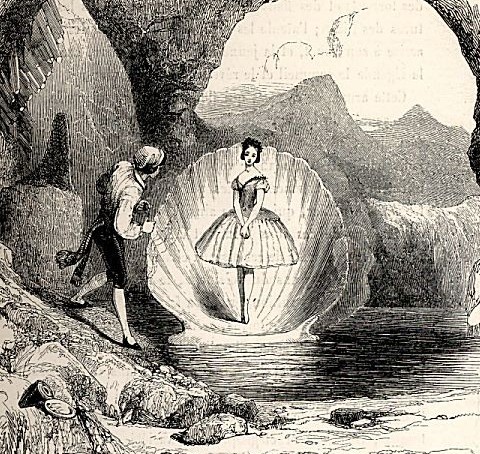
The first scene opens to reveal a crowd of Sicilian peasants gathering by the seashore, making preparations for the Festival of the Madonna. The fisherman Matteo and his fiancée Giannina are to be married the next day. Everyone departs, except Matteo, who casts his net into the sea when, to his amazement, a huge shell rises from the waters, bearing the naiad Ondine, whom he recognises as a spirit that has been haunting his dreams. Ondine is in love with Matteo and is determined to win his affections, despite the dangers that come from associating with mortals. Matteo is powerless to resist her supernatural enchantment and pursues Ondine along the shore and up a rocky slop. Upon reaching the summit, Ondine gives him a loving look before floating slowly down into the water, beckoning Matteo to follow her. Luckily, his friends arrive and stop him from leaping into the sea.
In the second scene, Matteo returns home to his mother and Giannina and tells them of the encounter with Ondine, but they do not believe him, with his mother dismissing it as a hallucination. Matteo helps Giannina to unwind a skein of thread, but the window flies open, and Ondine darts into the room, invisible to all. Unable to bear the sight of Matteo and Giannina together, the naiad mischievously vents her spite by snapping Giannina’s thread, striking the distaff out of the old woman’s hand and other pranks. She then becomes visible to Matteo and Giannina and flies out of the room, once again beckoning Matteo to follow her. He is again powerless to resist her but is restrained by Giannina from flying out of the window. Giannina chides him for his faithlessness, but Matteo swears he loves her only and all will be well in the morning. Later, when Matteo falls asleep, he comes under Ondine’s enchantment again when he dreams of the wonders of her underwater world, a world of sparkling grottoes and strange foliage where Ondine lives with her sister naiads. She appears to him again and throws herself at his feet. However, Hydrola, the Queen of the Naiads, Ondine’s mother, appears and warns her daughter that her desire to experience human love will deprive her of her immortality, but Ondine’s love is too intense for this warning to be heeded. She plucks a rose and declare her readiness to wither and die like the flower if only she can win Matteo’s love.
The scenes changes to the seashore where the Festival of the Madonna has begun and a colourful procession of the peasants and fisherfolk gathers to lay flowers at the statue of the Blessed Virgin Mary. After a frenzied tarantella, the bells toll and everyone kneels before the statue in prayer, but while they are praying, Ondine rises from a fountain, visible only to Matteo, who springs to his feet and pursues her, until Giannina chides him and brings him back to the shrine. However, when they resume their prayers, Matteo sees that Ondine has taken the place of the statue of the Virgin Mary. He turns to Giannina, but when they look back, the naiad has vanished. Night falls, the moon is rising, and the peasants disperse, leaving Matteo and Giannina alone on the shore. While Matteo unmoors his boat, Giannina notices something in the water and sees a group of naiads below the surface. Enchanted, she reaches out to them and is pulled underwater, while Ondine, having taken human form, rises from the water and takes her place. Stepping onto the shore, she sees her shadow for the first time and thinks it is someone following her, possibly Giannina, but when she looks closer, she realises that it is because of her new mortality and delightfully dances in the moonlight, playing with her shadow. At length, Matteo returns with his boat and Ondine has put on Giannina’s hat and cloak. Matteo, unaware that Ondine has taken Giannina’s place, helps her into the boat and they row across the bay while Giannina is borne away into the underwater regions of the naiads.
In the next scene, Ondine is asleep in Giannina’s bedroom where her mother appears to her, holding the withering rose and beseeching her to renounce her earthly existence before it is too late, but Ondine refuses and Hydrola vanishes. Ondine takes the withering rose and begins to feel very weak. Matteo enters and they dance together, but Ondine physically struggles with the weakness that is overcoming her. The final scene takes place at the wedding and Matteo and his bride make their way to the church, with the groom still unaware that the naiad has taken his fiancée’s place. Ondine is growing weaker and weaker and leans heavily on Matteo’s arm during the procession, walking with faltering steps. As they approach the church, Ondine is on the brink of death, but Hydrola will not leave her daughter and appears with the naiads in a last effort to save Ondine. She is in no state to resist and Hydrola restores Giannina to life. Giannina reclaims her rightful place as Matteo’s bride, the latter of whom is astounded by the miraculous recovery his bride seems to have made, while Ondine resumes her naiad form and returns to the sea, never to see her beloved again.
World première
Alongside Cerrito in the titular role, Perrot himself danced Matteo, though he had not quite recovered enough from his injury to perform heavy dancing. The role of Giannina was performed by French ballerina Marie Guy-Stephan.
Ondine, ou La Naïade premièred at Her Majesty’s Theatre in London on the 22nd June 1843 and was a huge success. Perrot’s choreography was praised, as was Pugni’s music, Cerrito’s performance and the scenic effects by the designer and machinist Grieve and Sloman. The apotheosis was especially spectacular where Ondine was borne away to her underwater home in a plethora of scenic effects – rainbows, ‘transparent walls of rippling water’ and coloured fountains, each enclosing a naiad, rising up from below the stage. Ondine was regarded as the best ballet seen on the London stage, as the critic of the Morning Post wrote,
“We have beheld ballets for thirty years at Her Majesty’s Theatre – we have seen some of the most successful of such performances in some of the most celebrated theatres in the greatest capitals of Europe – and we must in justice place Ondine far above them all. Music and dancing, painting and poetry – in this ballet all four comprised. We could never have believed that such a mise en scene could be effected; such scenic illusion produced in the few yards square that form the scanty stage at Her Majesty’s Theatre. We should feel greatly at a loss to apportion to the ballet-master, Perrot, the scene painter Grieve, etc., the share of praise each may justly claim. Good as the music is – sprightly, characteristic and descriptive – it is the least extraordinary portion of the ballet. Perrot’s maestria is perceptible in the minutest detail of the action of the ballet. The scenes are as varied as they are fascinating; at one moment representing nature with surpassing truth; at another embodying the poet’s imaginings in fairyland.”[1]
Perrot’s choreography for Ondine was greatly praised, especially for his perceptibility in every detail of the action. For many years, the London stage had presented ballet d’actions that were marred with dances that bore no significance to the plot and cut on the thread of the narrative, but for Ondine, Perrot successfully weaved the dances into the narrative, so all the dances were “combined movements”.
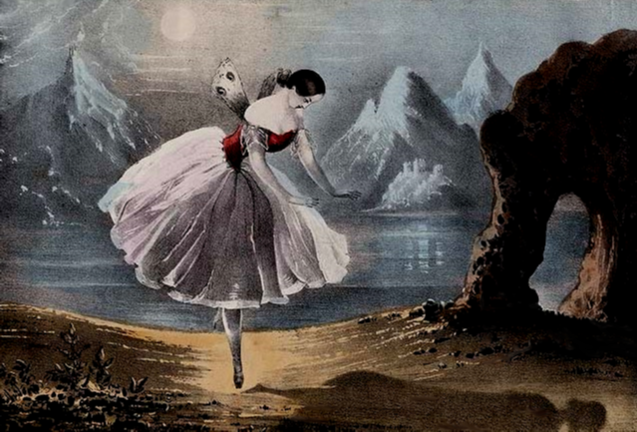
The ballet’s most famous passage is the Pas de l’ombre (aka the Shadow Dance) where Ondine plays with her shadow. After becoming mortal and stepping onto the shore in the moonlight, Ondine discovers that she now has a shadow. At first, she believes it to be her rival Giannina, but when discovering what it really is, she becomes delighted and excited and danced with her shadow on the moonlit shore. The Pas de l’ombre became the ballet and Cerrito’s signature dance. Cerrito held infectious joie de vivre in her dancing and Perrot wasted no time in exploiting her abilities to the full in this charming solo. Darting to and fro in the bright glare of the hydro-oxygen light that threw her shadow on to the stage before her, Cerrito’s performance of the Pas de l’ombre dazzled the audience: one witness recalled that when “bewildered with the novelty of her existence, [Ondine] for a moment believes the shadow to be her rival, and plunges into the lake to convince herself of her error.”[2] Another wrote of the passage where “she clutches the shadow on the ground and like an infant is innocently astonished at the dark, elongated monster which perseveringly mimics her movements.”[3]
When Sir Frederick Ashton choreographed his Ondine ballet for Margot Fonteyn in 1958, he added a Shadow Dance as an homage to Perrot. Ashton even owned an oil painting of Fanny Cerrito in an arabesque pose from Perrot’s pas de l’ombre.
Ondine remained in the London repertoire from 1843 to 1848 and was last performed at Her Majesty’s Theatre in 1851. In 1845, itwas one of several ballets that was staged by Jean Petipa, father of Marius Petipa, in Madrid, with Marius in the role of Matteo and dancing Marie Guy-Stéphan dancing Ondine in an upgrade from the secondary ballerina role of Giannina. Fanny Cerrito performed the role of Ondine for the final time when she performed the final act of the ballet for her benefit in Saint Petersburg on the 26th February 1857, several months before she retired from the stage.
Perrot’s tenure as Ballet Master in London came to an end in 1848 after nearly a decade of staging many acclaimed and successful works and by 1849, he was serving as Premier Maître de Ballet to the Saint Petersburg Imperial Theatres. Pugni followed Perrot to Russia, where the composer was given the post of official Ballet Composer. Like most European theatres of that time, Her Majesty’s Theatre in London only produced ballets as one or two-act diversions between scenes of operas, but the opera houses of Russia devoted entire evenings exclusively to ballet. In light of this, Perrot staged many of his works that had been mounted previously in London in elaborately expanded editions for the Saint Petersburg stage, requiring not only that Perrot add and embellish his original dances and mise-en-scène, but also that Pugni expand his scores.
Ondine in Russia
Like nearly all ballets and operas of that time, irregardless of critical acclamation and/or financial success, Ondine faded quickly from the repertoires of most European opera houses, but it found a permanent home in Russia. Perrot’s Saint Petersburg staging differed vastly from his original London staging, with only about a sixth of the 1843 version being retained. Pugni extensively revised his score, composing many new musical numbers and the libretto underwent change. The ballet was expanded from two acts to three acts and was even given a new title – it was now called The Naiad and the Fisherman. One prime example of a change made to the libretto was the ending, most likely by the influence of Carlotta Grisi, who danced the title role in the 1851 production. In the original 1843 London production, the ballet ended with Ondine sacrificing herself in favour of Matteo and Giannina’s happiness, primarily because she was unable to physically adapt to life as a mortal and accepted the chance to be rescued from death. Matteo and Giannina were happily reunited and Ondine resumed her naiad form and returned to the sea forever, never to see her beloved again. The 1851 staging, however, ended on a different note in favour of Ondine – when Ondine returned to the sea as a naiad, Matteo followed her into the water and drowned. The ballet ended with Ondine and the drowned Matteo kneeling before Hydrola, the Queen of the Naiads, who blessed their union, while Giannina was seen trying in vain to reach Matteo, but was blocked by a wall of water that rose out of a fountain.
Perrot’s 1851 staging of the newly renamed ballet, The Naiad and the Fisherman was met with great success in Saint Petersburg. On the 23rd July [O.S. 11th July] 1851, a special one-act performance of the ballet was given at Peterhof Palace for the name day of the Grand Duchess Olga Nikolaevna, daughter of Tsar Nicholas I. For this performance, a stage was erected above the waters of the lake of the Ozerky Pavilion.

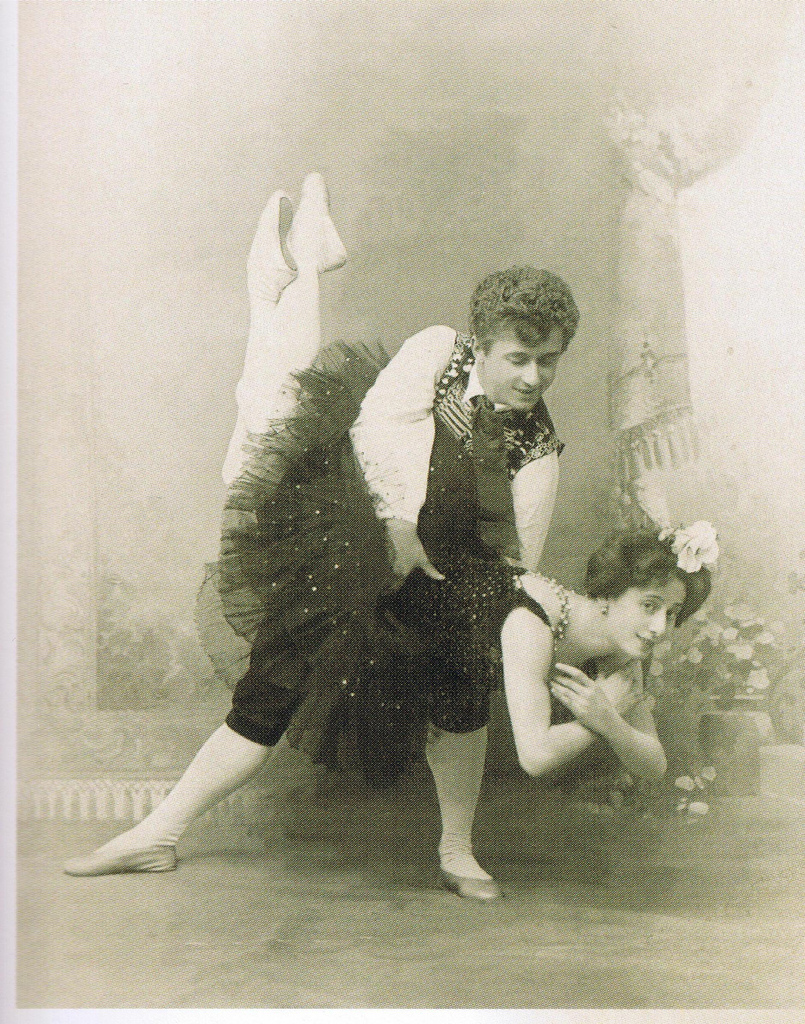
Following Perrot’s departure from Russia, Petipa later went onto stage two revivals of The Naiad and the Fisherman. His first revival was staged for Eugenia Sokolova in 1874 and in this revival, he revised the entire ballet, with Ludwig Minkus composing new music numbers. Petipa’s final revival of The Naiad and the Fisherman was staged for Varvara Nikitina, with more musical revisions, this time, by Riccardo Drigo. The revival premièred on the 2nd October [O.S. 20th September] 1892.
The Naiad and the Fisherman was revived for a final time in 1903 by Pugni’s grandson, Alexander Shiryaev, who was second ballet master of the Imperial Theatres at the time. Shiryaev revived his grandfather’s ballet for Anna Pavlova and the revival premièred on the 20th December [O.S. 7th December] 1903. This was to be the final revival of The Naiad and the Fisherman that would be staged for and danced by the Imperial Ballet. Shiryaev revived the ballet again in 1921 for the Leningrad Choreographic Institute (now, the Vaganova Academy) and the ballet was performed for the final time in Saint Petersburg in 1931, after which, it was never performed in Russia again.
Perrot’s version of Ondine was notated by Henri Justament in the 1860s. All that survives of the Imperial Ballet production are two variations from the second act that were notated in Stepanov notation and are part of the Sergeyev Collection. These two variations are those of Tamara Karsavina and her classmate Elena Poliakova.
The Naiad and the Fisherman in the 20th Century
Today, the only piece associated with Petipa’s revival of The Naiad and the Fisherman is a variation that Riccardo Drigo composed for Anna Johansson in Petipa’s 1892 revival, which is traditionally performed today in the Paquita Grand Pas Classique. It has also appeared in 20th century productions of The Little Humpbacked Horse in the Underwater scene of the final act, in which Ivanushka and the Humpbacked Horse travel to the bottom of the Arctic Ocean to retrieve the Tsar Maiden’s lost ring.
Variation for Anna Johansson, composed by Drigo (1892)

The Naiad and the Fisherman was one of Anna Pavlova’s favourite ballets and as part of her company’s repertoire, she danced a short pas d’action entitled Ondine, which was inspired by the full-length ballet. However, Pavlova did not use any of Pugni’s music or any of the musical additions by Drigo or Minkus for her Ondine pas d’action. Instead, she used a number from Alfredo Catalani’s 1880 opera Elda.
In 1958, Sir Frederick Ashton created a brand new version of Ondine to music by Hans Werner Henze and a libretto that was a much more faithful adaptation of Friedrich de la Motte Fouqué’s novella for Dame Margot Fonteyn. Ashton’s Ondine premièred on the 27th October 1958 at the Royal Opera House, Covent Garden. Other original cast members included Michael Somes as Prince Palemon, Julia Farron as Berta and Alexander Grant as Tirrenio.
In 1984, Shiryaev’s student, Pyotr Gusev staged a suite of extracts from The Naiad and the Fisherman that he claimed to be Perrot’s original choreography for a gala performance held at the Kremlin in Moscow in honour of his 80th birthday. Gusev claimed that he remembered the choreography for the ballet and was able to distinguish the passages that derived from Perrot’s original version.
In 2006, Pierre Lacotte choreographed and staged a new version of Perrot and Pugni’s ballet under the original title of Ondine for the Mariinsky Ballet. The production was based on the original two-act 1843 London production, though it included some musical numbers from the Saint Petersburg productions, including a pas de deux that Riccardo Drigo composed for Anna Pavlova in Shiryaev’s 1903 revival. Lacotte’s Ondine premièred at the Mariinsky Theatre on the 16th March 2006, but the production has not been staged and performed for some time.
Pas de l’Ombre
The Pas de l’Ombre (aka the Shadow Dance) is the most famous passage from The Naiad and the Fisherman, in which Ondine plays with her shadow. In the original 1843 production, Ondine first discovered her shadow after becoming mortal and stepping onto the shore in the moonlight. At first, she believed her shadow to be a rival for Matteo’s affections, but when discovering what it really was, she became delighted and danced with it on the moonlit shore.
Related pages
Photo gallery
References
[1] Quoted in Jules Perrot: Master of the Romantic Ballet by Ivor Guest, p. 105
[2] Quoted in Jules Perrot: Master of the Romantic Ballet by Ivor Guest, p. 104
[3] Quoted in Jules Perrot: Master of the Romantic Ballet by Ivor Guest, p. 104
Sources
- Guest, Ivor (1985) Jules Perrot: Master of the Romantic Ballet. London, UK: Dance Books Ltd
- Werner, Henze, Hans (1959) Ondine: Diary of a Ballet. (Translated edition, 2003), Alton, Hampshire: Dance Books Ltd
- Manchester, P. W. Liner note for the LP record “Homage to Pavlova” (CSA 2232). Decca Records, 1974
- Mariinsky Ballet: Theatre program from Ondine. Mariinsky Theatre, 2006
Photos and images: © Dansmuseet, Stockholm © Большой театр России © Victoria and Albert Museum, London © Государственный академический Мариинский театр © CNCS/Pascal François © Bibliothèque nationale de France © Musée l’Opéra © Colette Masson/Roger-Viollet © АРБ имени А. Я. Вагановой © Михаил Логвинов © Михайловский театр, фотограф Стас Левшин. Партнёры проекта: СПбГБУК «Санкт-Петербургская государственная Театральная библиотека». ФГБОУВО «Академия русского балета имени А. Я. Вагановой» СПбГБУК «Михайловский театр». Михаил Логвинов, фотограф. Martine Kahane.
 The Marius Petipa Society