
Ballet pantomime in two acts and six scenes
Music by Giovanni Felis & Cesare Pugni
Libretto by Arthur Saint-Léon
Décor by Despléchin & Thierry
Costumes by Paul Lormier
World première
19th January 1849
Salle Le Peletier, Paris
Original 1849 Cast
Hélène de Vardeck
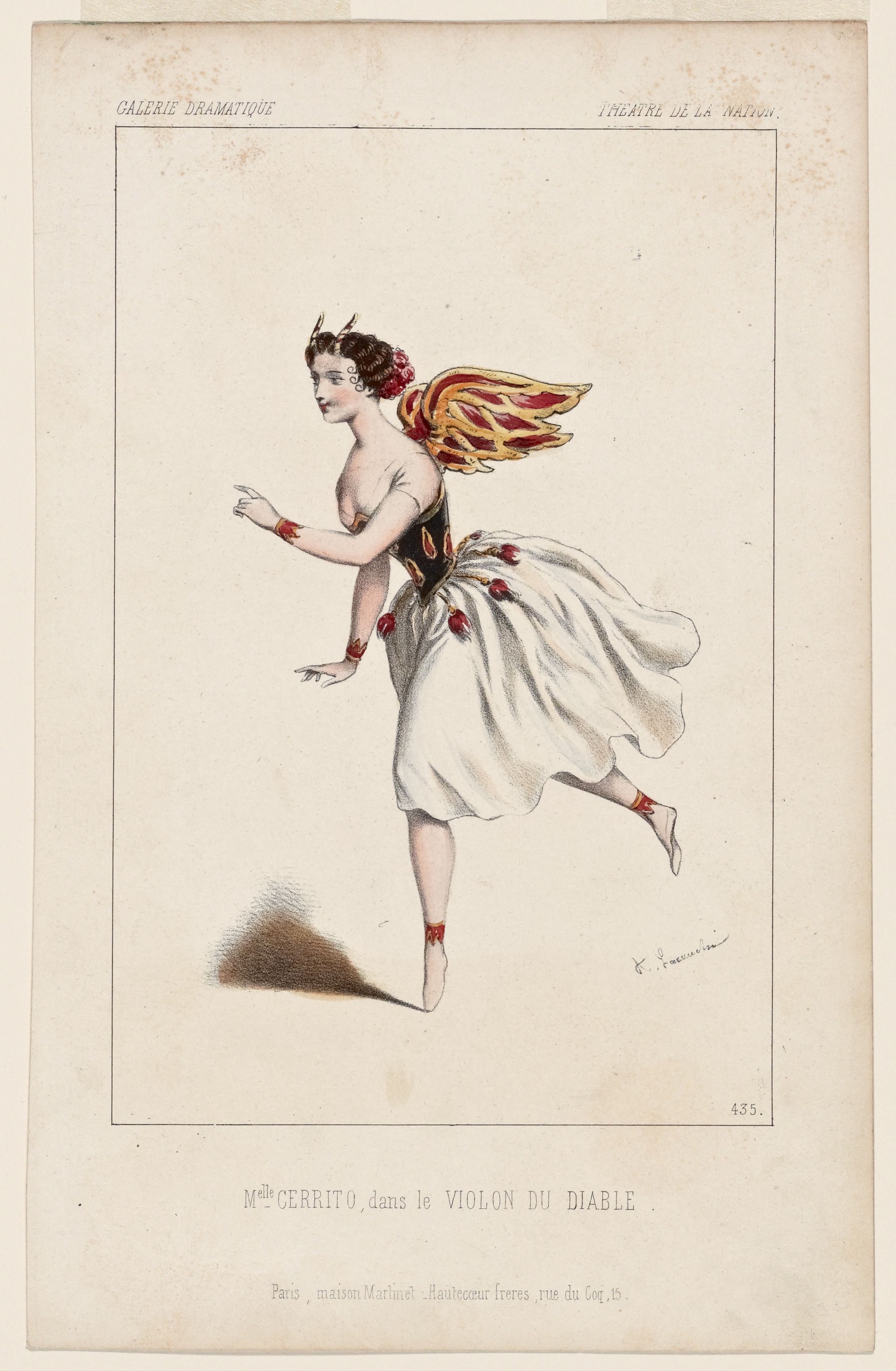
Fanny Cerrito
Urbain
Arthur Saint-Léon
Saint-Ybars
Alexandre Fuchs
Dr Mathéus
Eugene Coralli
Father Anselme
Hilaire Cornet
History
Le Violon du Diable is a two-act ballet created by Arthur Saint-Léon and Cesare Pugni. Months after Saint-Léon and Fanny Cerrito’s return to Paris in 1848 when they introduced La Vivandière to the French capital, Saint-Léon would stage a new ballet, one that was more elaborate than those he had previously staged and arranged at the Opéra, entitled Le Violon du Diable.
Le Violon du Diable was a revival of Saint-Léon’s ballet Tartini il Violinista, which he had created in Venice and had premièred at the Gran Teatro la Fenice on the 29th February 1848. According to the programme, Tartini il Violinista was based on a work by French illustrator Paul Gavarni, and the music score was a shared composition between Giovanni Felis and Pugni – Felis composed the first act, while Pugni composed the second. An interesting feature of this ballet is that Saint-Léon presented himself in three artistic forms – as choreographer, as Premier Danseur and as a violinist, performing a solo in the prologue and in the second act, playing an obbligato while Cerrito danced a pas dell’angelo. Tartini il Violinista was well-received in Venice and now came the time to present the ballet to the Parisian audiences. Although the Venetian programme had credited the music to “Saint-Léon and Felis, with the exception of the second act, which is by Cesare Pugni,” the Paris programme only credited Pugni as the composer.1

Libretto
The story tells of Urbain, a young violinist who is in love with Hélène de Vardeck, but she herself is in love with a rival suitor Saint-Ybars. The sinister Dr Mathéus puts a spell on Urbain’s violin so that its tune will have an irresistible effect on Hélène’s heart in exchange for Urbain’s soul. Urbain refuses to make such a deal, and the doctor breaks the magic instrument, causing the former to lose his reason in despair at the thought of losing his loved one. However, the saintly Father Anselme gives Urbain another violin, which is instilled with beneficial magic and no less potent. Urbain succeeds in winning Hélène’s love, and it is then discovered that Urbain is really of noble birth. With this, Hélène’s father gives his consent to their marriage. Their betrothal is celebrated with a divertissement entitled Les Fleurs animées that was inspired by the drawings of Grandville,in which Urbain represents a gardener who is captured by flowers in revolt against his tyranny and is carried off to the Kingdom of the Dew, where he falls in love with the Queen, played by Hélène.2
World première
Le Violon de Diable premièred on the 19th January 1849, with Cerrito as Hélène and Saint-Léon as Urbain. The ballet was very well received as it had been in Venice. Cerrito and Saint-Léon were both praised for their performance, with many praising the latter for presenting himself in a multiple capacity.
Jules Janin wrote of Saint-Léon:
“This M. Saint-Léon is a real demon… He dances a hundred times better than the famous Zephyr of 1820 who was called Paul-Zephyr; he plays the violin like Mlle Milanollo; he prepares a ballet as well as Théophile Gautier himself. These are enough vices for any man, enough to make three poor devils happy, enough to make three fortunes, three gods. Oh, thrice-supreme Saint-Léon!”3
Of Cerrito, Janin wrote in the same review:
“Until today Paris knew little of Cerrito, of her tireless strength, her surprising and charming combination of every coquetry of foot, hand, figure, pose, gesture, and look!”4

Many of the other critics shared Janin’s enthusiasm, including Théophile Gautier, who said Cerrito danced like a Grace, but there was one critic who could be trusted to say nothing kind and that was Charles Maurice, a fervent opposer to Saint-Léon and Cerrito. Of Saint-Léon’s abilities as a violinist, Adolphe Adam wrote:
“Saint-Léon belongs to the Paganini school. He seeks his principal effects in the eccentricities and the difficulties of harmonies and the succession of pizzicato and col arco, which does not prevent him from playing with infinite style and elegance the air varié and the various andante passages of which his musical rôle is composed. Account must also be taken of the extreme difficulty of taking up the violin in the middle of a scene and playing it at a given moment, without time to make all the preparations that a musician never neglects before commencing his solo.”5
Le Violon de Diable was given a total of 50 performances at the Paris Opéra between 1849-1852. Several months later, for their summer season, Saint-Léon and Cerrito were due to travel to Stockholm, Sweden, but their plans were disrupted by the First Schleswig War. Forced to change their plans, they went straight to Königsberg in the Kingdom of Prussia where Le Violon du Diable was one of five ballets Saint-Léon staged for their performances. The ballet does not seem to have made many appearances around Europe, but on the 4th April 1851, Cerrito and Saint-Léon staged and appeared in the ballet at the Teatro Real in Madrid. The year after Saint-Léon and Cerrito’s marriage broke down, the last known performance of Le Violon du Diable took place on the 6th February 1852 at the Paris Opéra with Saint-Léon’s student Héloïse Guérinot, who used the stage name Regina Forli, in the role of Hélène, but that same year, it was retired from the repertoire and fell into obscurity.

References
- Ivor Guest, p.124, Fanny Cerrito: The Life of a Romantic Ballerina (1956), London, UK: Phoenix House Ltd ↩︎
- Ivor Guest, p.129, Fanny Cerrito: The Life of a Romantic Ballerina (1956), London, UK: Phoenix House Ltd ↩︎
- Quoted in Ivor Guest’s Fanny Cerrito: The Life of a Romantic Ballerina, p. 129, (1956), London, UK: Phoenix House Ltd ↩︎
- Quoted in Ivor Guest’s Fanny Cerrito: The Life of a Romantic Ballerina, p. 129, (1956), London, UK: Phoenix House Ltd ↩︎
- Quoted in The Ballet of the Second Empire, p. 44, by Ivor Guest(1956, 2014 ed.), Hampshire, UK: Dance Books Ltd ↩︎
Sources
- Ivor Guest (1956) The Ballet of the Second Empire (2014 ed.), Hampshire, UK: Dance Books Ltd
- Ivor Guest (1956) Fanny Cerrito: The Life of a Romantic Ballerina. London, UK: Phoenix House Ltd
 The Marius Petipa Society