
Ballet fantastique in two acts and four scenes
Music by Jacque Offenbach
Libretto by Jules Henri Vernoy Saint-Georges
World Première
26th November 1860
Salle Le Peletier, Paris
Original 1860 Cast
Farfalla
Emma Livry
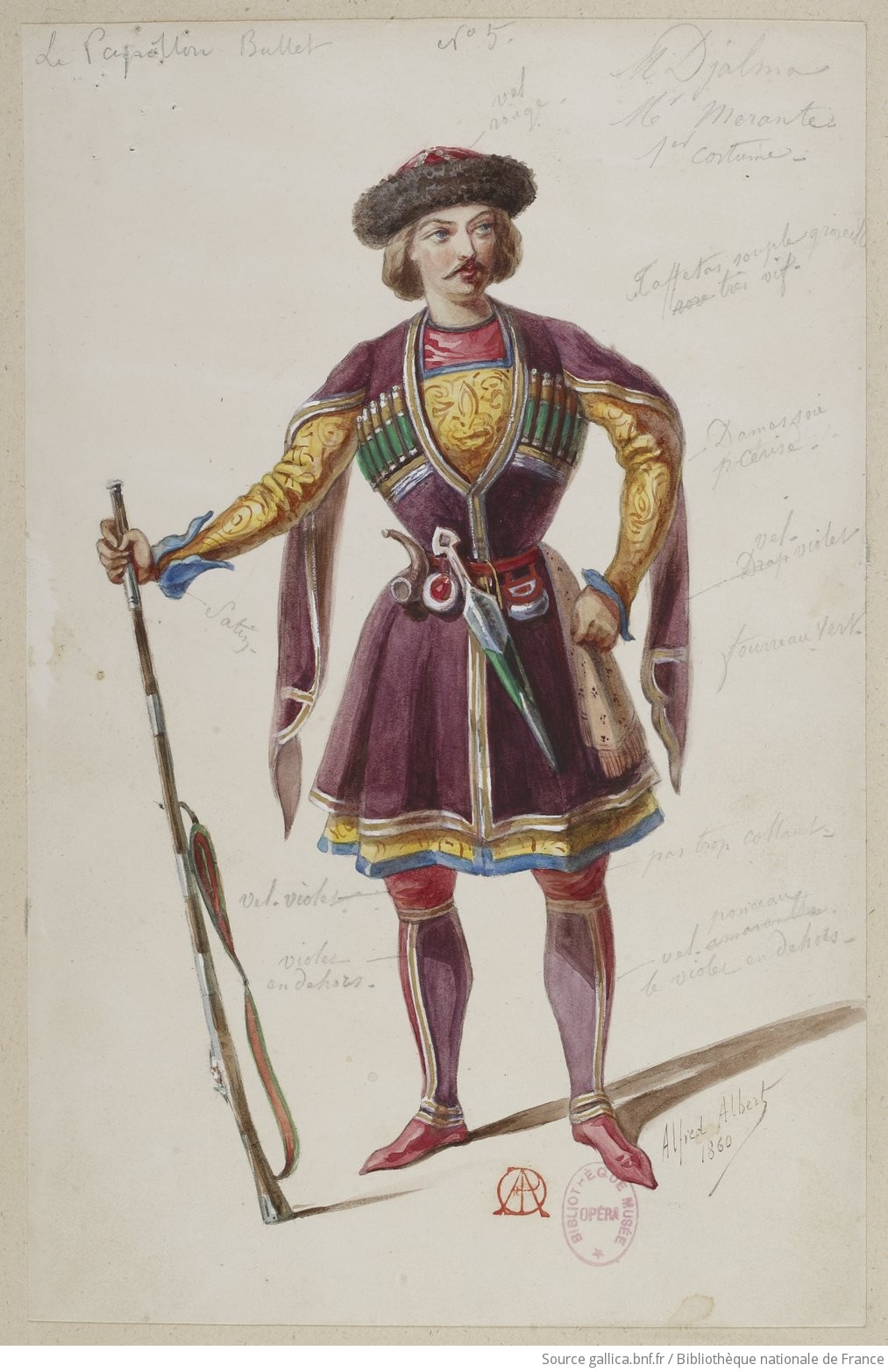
Prince Djalma
Louis Mérante
Hamza
Louise Marquet
Patimate
Francisque Berthier
Mohamed
Francois Dauty
Zaidée
Julie Stoikoff
Ismail Bey, Emir
Louis Lenfant
Leila
Héloise Lamy
The Diamond Fairy
Alexandrine Simon
The Pearl Fairy
Virginie Maupérin
The Flower Fairy
Élisa Troisvallets
The Harvest Fairy
Eugénie Scholosser
Première of Petipa’s revival
6th January 1874
Imperial Bolshoi Kamenny Theatre, Saint Petersburg
Original 1874 Cast
Farfalla
Ekaterina Vazem
Prince Djalma
Lev Ivanov
Hamza
Matilda Madaeva
Patimate
Pavel Gerdt
The Diamond Fairy
Lyubov Radina
History
The Butterfly (Le Papillon) was originally created by Marie Taglioni for her young protégée, the French ballerina Emma Livry. After Livry’s triumphant début in La Sylphide in 1858, a new star was born at the Opéra and Taglioni, who had been invited to Paris to watch her perform the Sylph, took the young dancer under her wing.

Fig 1. Emma Livry as Farfalla (1860)Livry’s career quickly developed when she danced the leading role in a divertissment in the opera Herculanum in 1859 and considering her performance’s success, it was decided that a new ballet would be created for her. The ballet was commissioned with Taglioni as the choreographer, Saint-Georges as the librettist and Jacques Offenbach as the composer. This all indicates that hopes were every high for Emma Livry’s future. The aim of the new ballet was to give her a role with which she would become identified, like Taglioni had with the Sylph and Carlotta Grisi with Giselle. Work on the new ballet began around late 1859, early 1860 with rehearsals continuing throughout the spring of 1860. That same year, Taglioni’s father, the eighty-one-year-old Filippo Taglioni returned to Paris for an operation to restore his failing eyesight and in November, he returned again to watch one of the last rehearsals of his daughter’s new ballet. However, he was severely critical, complaining that “Nothing is in time,” but he was somewhat impressed by the pas, stating that they were “well arranged and very pretty”.1
Libretto
For the new ballet’s libretto, in keeping with the style of other post-Romantic Ballet scenarios he had written, most notably La Filleule des fees, Saint-Georges opted for another fairy tale story that was devoid of complexities and had a lighter tone than those of the dark, tragic Romantic Ballets, especially La Sylphide and Giselle. The new ballet would be one that told the story of good and evil fairies, an enchanted princess who is cursed by the evil fairy, and the lovestruck prince who sets out to rescue her. The title of the ballet was decided at the last moment. Saint-Georges’s original idea was Zaidée, which he had intended to be the name of the heroine, but Marie Taglioni requested Farfalla, the Italian word for butterfly. Royer, the Opéra director, preferred for the title Le Papillon et le Fée (The Butterfly and the Fairy), but those who were guarding Emma Livry’s interests objected, arguing that such a title took the focus away from her and gave too much prominence to a secondary character. After some discussion, it was finally decided that the ballet would be simply called Le Papillon.
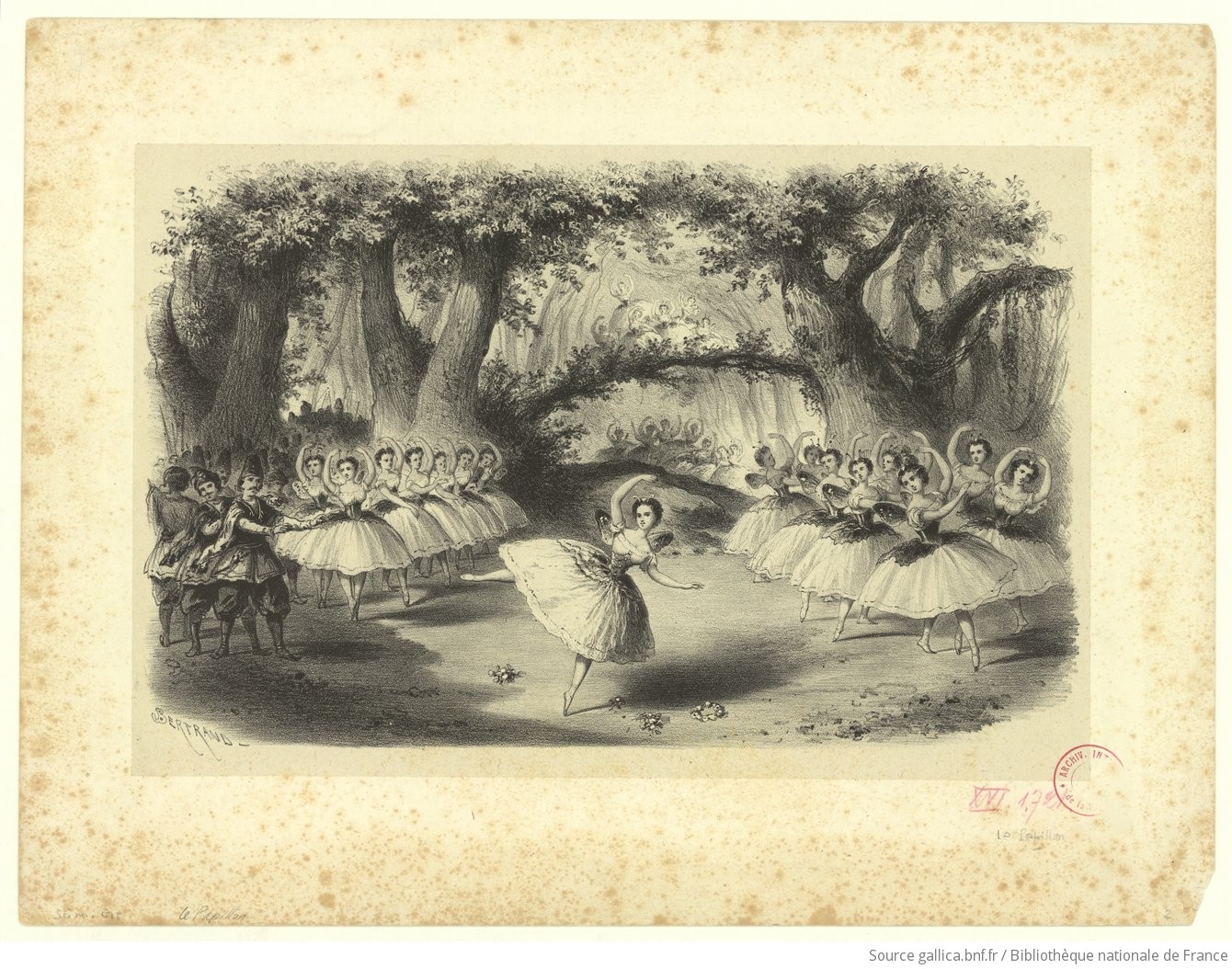
The first act takes place in a forest. The evil fairy Hamza has been turned into an ugly woman for previous misdeeds and will only recover her beauty if someone kisses her. However, nobody wants to kiss such an ugly creature, so to attract young men, Hamza has kidnapped the Emir’s daughter Farfalla and hides with her in a cottage in the forest, where Farfalla serves the fairy as her maid. The young Prince Djalma is out hunting and comes across the cottage. He stops to ask for refreshment and Hamza sees this as the opportunity she has been waiting for. However, when the prince sees Farfalla, he falls in love with her and kisses her, much to Hamza’s resentment. When Djalma and his party leave, Hamza loses her temper with Farfalla and transforms her into a butterfly. In the forest, Djalma is given a butterfly that a member of his party has caught and pins it to the trunk of a tree, but as he does so, the butterfly transforms into Farfalla. She escapes from his grasp, only to be caught by Hamza. Patimate, a woodsman, witnesses this and recognises Hamza as the kidnapper of the Emir’s missing daughter. He seizes her magic wand, which causes her to lose her powers, and frees Farfalla. Though an evil sprite snatches the magic wand from him, Farfalla manages to escape when the other butterflies come to her aid, imprisoning Hamza in the net in which she intended to trap Farfalla.

The second act takes place at the Emir’s palace. Hamza is brought before the Emir and is made to confess her crimes and restore his daughter to him. Farfalla returns to her father, attended by a rich suite, and is introduced to Djalma as his future bride. Djalma is overjoyed, but Farfalla, remembering the wound he inflicted upon her, repulses him. As he tries to embrace her, Hamza intercedes, receiving the kiss instead, and is transformed back into a beautiful woman. While the betrothal of Djalma and Farfalla is celebrated, Hamza treacherously turns Farfalla back into a butterfly and puts a spell on Djalma, conjuring up a vision of an enchanted garden before his eyes. It is here that she plans to marry him herself. Her sisters – the Diamond Fairy, the Pearl Fairy, the Flower Fairy, and the Harvest Fairy – arrive for the wedding, and a young Hymen appears with a lighted torch. Attracted by the flame, Farfalla darts forward but approaches too close and her wings are burned, which breaks Hamza’s spell, restoring her to human form. Hamza is furious, but her sisters turn her into a statue. Farfalla and Djalma are reunited, and the fairies conduct them towards a magnificent palace in the enchanted Fairy Kingdom where they are married.2
World Première
Le Papillon premièred at the Paris Opéra on the 26th November 1860 with Livry as Farfalla, Louis Mérante as Prince Djalma and Louise Marquet as Hamza. The première was attended by a full house and Emperor Napoleon III, and everyone had high expectations for this ballet that had been so long in preparation and had many exciting possibilities with its combination of the choreographer, composer, and lead ballerina. However, the ballet was met with a mixed response as it proved to be quite disappointing in many respects. The plot was criticised for lacking simplicity and flow, and many felt that it had relied too much on the scenic effect. Offenbach’s score was also criticised, but this mainly came from music purists who were shocked that such a composer of popular music should be given a hearing with the walls of the Opéra. The more open-minded, who listened without forming their opinions in advance, gave a more positive reaction, praising the skilful orchestration and the abundance of melodies. Some of the numbers that were particularly praised were the Valse des rayons, the mazurka entitled La Lezginka, the Bohémienne and a pastoral march.
Little was said about Marie Taglioni’s choreography, only that her pas were varied, and the groups were well designed, but she accomplished her task of providing Emma Livry with the means of triumph. Livry’s performance was a huge success with the critics praising her “exquisite charm” and “rare audacity” and compared her to her coach. Taglioni had succeeded in passing her style from her days of glory to her young protégée: many in the audience who had seen Taglioni dance recognised her gestures and mannerisms in Livry’s performance. During the curtain call, Taglioni and Livry took a call together, almost in each other’s arms, and the whole house responded with thunderous applause and cheering. Despite its shortcomings, Le Papillon had been given its place in the Paris Opéra as a vehicle for its new star ballerina.

Le Papillon was regularly performed for many months after the première, with Emma Livry always dancing her role of Farfalla, and was performed a total of forty-two times between 1860 and 1862. On the 18th October 1861, the ballet gave its thirty-seventh performance before the King of Holland. Emma Livry performed in Le Papillon for the last time in September 1862, but she was never to perform her signature role again after the horrific accident that occurred on the 15th November 1862. During rehearsals for the opera La Muette de Portici, Livry was horrifically burned when her costume caught alight on one of the theatre gas lamps and she sustained horrific full thickness burns. This tragic accident ended not only Livry’s career, but her life as she died nine months later on the 26th July 1863, aged 20.
Le Papillon would never be performed at the Paris Opéra again, but on two occasions, there were discussions of a potential revival. The first was in 1867 for Henriette Dor and the second in 1870, but nothing ever came of these discussions, most likely because no one had the heart to revive a ballet that had such a terrible tragedy attached to it. Therefore, Le Papillon remained retired in Paris, but its legacy and the legacy of Emma Livry lived on.
Le Papillon in Russia
In 1874, eleven years after Emma Livry’s death, Le Papillon was brought to Russia when it was chosen for Ekaterina Vazem. Petipa extended the ballet from two acts to four and Ludwig Minkus composed brand new music for Offenbach’s score.
Vazem gives an account of Petipa’s revival in her memoirs:
“At the beginning of 1874, I appeared for the first time in a grand ballet produced by Petipa especially for me – The Butterfly. The story of the ballet, written by the Parisian ballet librettist St-Georges, was not, God knows, especially engaging. At the time this ballet was produced, Petipa probably took into account that a ballet The Butterfly, to the same scenario but with music by Offenbach, had been performed successfully in Paris by the ballerina Emma Livry, who was burned on the stage of the Grand Opéra during a dress rehearsal of the opera La Muette de Portici. Minkus wrote the music for The Butterfly here; Petipa produced very many dances for this ballet, and in general they were interesting. Here, incidentally, in the ‘Dances of the Butterflies’, I had a variation to the music of a waltz by Venzano, which at the time enjoyed great popularity. The celebrated Adelina Patti sang it at the Italian opera in Donizetti’s Linda di Chamounix. In this variation, which began with temps requiring elevation, I made two pirouettes renversées on pointe and stopped, as they say in ballet, à la seconde (in second position). This was new. Before that [Henriette] Dor did the same pirouettes in Le Corsaire, which astonished everyone, but only on demi-pointe, which was much easier. The variation ended with my jumping on one pointe, which no ballerina had ever done before. The balletomanes immediately christened this pas the ‘Vazem Variation’, similar to the Ferraris, Dor, [Adele] Grantzow Variations, etc., already in existence. As regards participants in the performance, The Butterfly was well produced. [Nikolai] Golts, Lev Ivanov and Alexandre Bogdanov played its acting roles, and all the best soloists performed the dances, led by [Mathilda] Madaeva, [Lubov] Radina, [Felix] Kschessinsky and of course [Pavel] Gerdt, who excelled in his ethereal variation in the ‘Dances of the Butterflies’. The character dances were very effective: Persian, Malabar, and especially the dance of the Circassian women, performed by the corps de ballet armed with lances.“3
In 1976, Pierre Lacotte staged his own version of Le Papillon for the Paris Opera Ballet, which he later staged for the Kirov/Mariinsky Ballet in 1979. The most famous piece associated with the ballet today is Lacotte’s staging of the Le Papillon Pas de deux, which the Mariinsky Ballet has often danced in gala performances.

Related pages
Libretto
Footnotes
- Ivor Guest, The Ballet of the Second Empire, p. 141 ↩︎
- Ivor Guest, The Ballet of the Second Empire, p. 141-43 ↩︎
- From Memoirs of a Ballerina of the St Petersburg Bolshoy Theatre, 1867-1884, Chapter 11, by Ekaterina Ottovna Vazem (quoted in A Century of Russian Ballet, 1810-1910 by Roland John Wiley, 2007) ↩︎
Sources
- Ivor Guest (1953) The Ballet of the Second Empire. Middletown, Connectivut, US: Pitman & Wesleyan
- Roland John Wiley (2007) A Century of Russian Ballet. Alton, Hampshire, UK: Dance Books Ltd
Photos and images: © Dansmuseet, Stockholm © Большой театр России © Victoria and Albert Museum, London © Государственный академический Мариинский театр © CNCS/Pascal François © Bibliothèque nationale de France © Musée l’Opéra © Colette Masson/Roger-Viollet © АРБ имени А. Я. Вагановой © Михаил Логвинов © Михайловский театр, фотограф Стас Левшин. Партнёры проекта: СПбГБУК «Санкт-Петербургская государственная Театральная библиотека». ФГБОУВО «Академия русского балета имени А. Я. Вагановой» СПбГБУК «Михайловский театр». Михаил Логвинов, фотограф. Martine Kahane.
 The Marius Petipa Society