
Ballet-pantomime in three acts
Music by Friedrich Flotow, Friedrich Burgmüller & Édouard Deldevez
Choreography by Joseph Mazilier
Libretto by Jules-Henri Vernoy de Saint-Georges
World Première
21st February 1844
Salle Le Peletier, Paris
Original 1844 Cast
Lady Henriette
Adèle Dumilâtre
Nancy
Maria
Lyonnel
Lucien Petipa
John
Jean Baptiste Barrez
Mina
Sophie Dumilâtre
Alison
Célestine Emarot
Sir Tristan Crakfort
Georges Elie

History
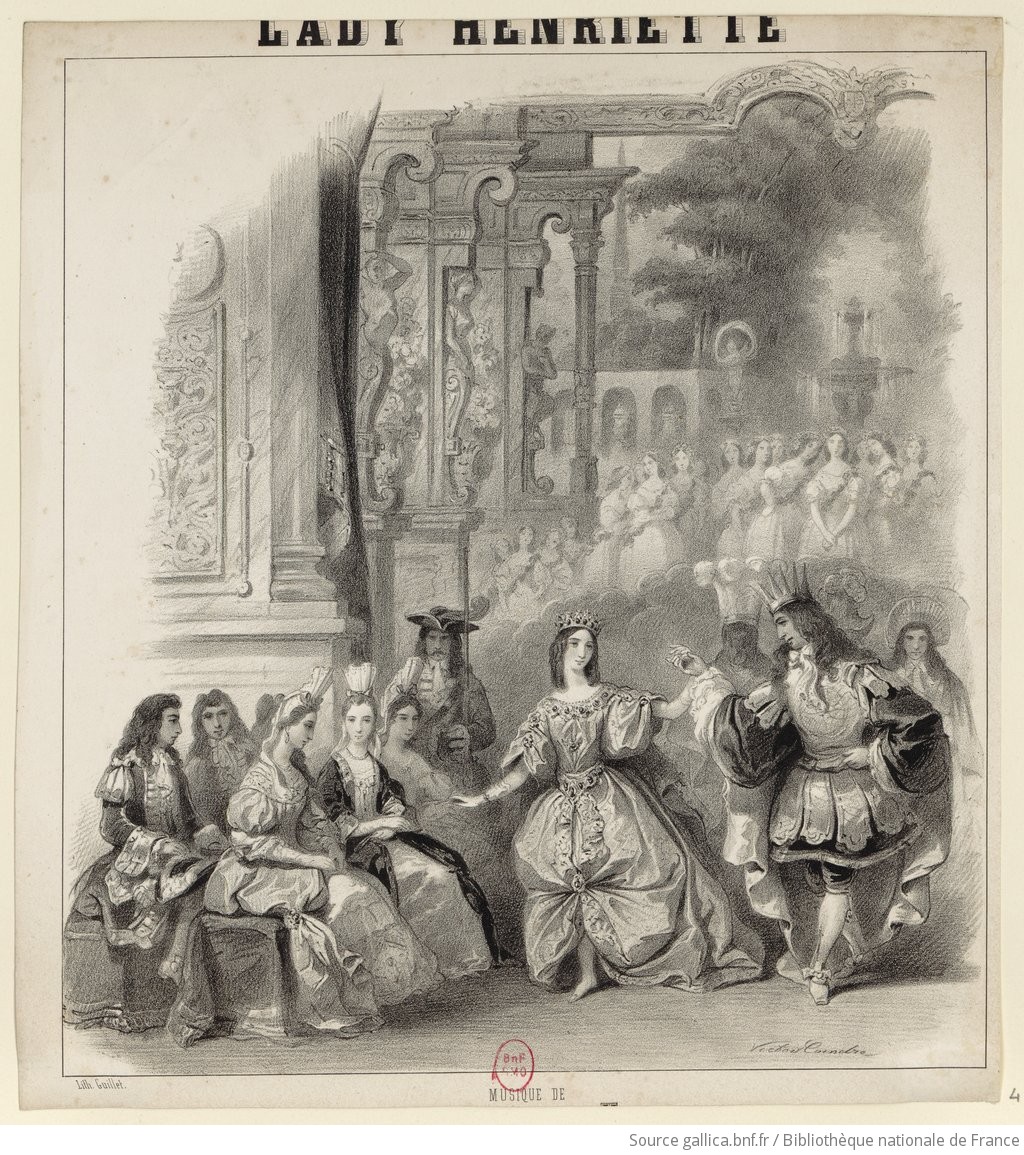
Lady Henriette, ou la Servant de Greenwich is a three-act ballet by Joseph Mazilier. In 1844, Carlotta Grisi was absent from Paris due to her contract to dance in London for the first half of the Opéra season. This meant that the Opéra Director, Louis Pillet, couldn’t present his star ballerina in a new work for months. By the conditions of his management, Pillet was obliged to replenish the repertoire with a specified number of new works each year. With Grisi currently out of the picture, there were three other ballerinas at the Opéra, all very talented, but, in the eyes of the public, of considerably less magnitude.

They were Pauline Leroux, whose fitness was in much doubt; Maria Jacob (simply known as Maria), and the still-inexperienced Adèle Dumilâtre. Of the three, the most aspiring was the 22-year-old Dumilâtre, who was not only very ambitious but was already making her mark following her début as the Sylph and her originating the role of Myrtha in Giselle in 1841. When Saint-Georges submitted his newest libretto for a new ballet in the summer of 1843, Pillet’s first thought was to cast Dumilâtre in the lead role. However, he then began to doubt if she was ready to develop a character in pantomime throughout the course of a three-act ballet. When the Royal Commissioner, Edouard Monnais summoned Pillet to his office where the latter explained his reluctance to incur the heavy outlay that the production of the new ballet in planning would entail with a dancer of Dumilâtre’s standing in the leading role. Monnais did not insist that Pillet should change his mind, but a few days later, a gentleman was shown in Pillet’s office, where he offered the sum 100,000 francs on condition that the new ballet would be produced for Dumilâtre with all possible speed. The bribe worked. Work on the ballet went underway with Saint-Georges’s libretto, Joseph Mazilier was commissioned as the choreographer and cast alongside Dumilâtre were Lucien Petipa as Lionel and Maria as Nancy. For the music, three composers were commissioned, each of them assigned to compose each act – Friedrich von Flotow, who was assigned Act 1; Friedrich Burgmüller, who was assigned Act 2; and Édouard Deldevez, who was assigned Act 3. Pillet’s decision to assign three composers to compose each act was considered fundamentally flawed, but according to one critic, it was prompted by the last-minute rush to present a new ballet.
Libretto
For his libretto, Saint-Georges was inspired by a play that had been produced some years ago at the Théâtre des Variétés entitled La Comtesse d’Egmont. When adapting the book into a ballet libretto, he changed the setting from the Versailles of Louis XV’s regency to Windsor under Queen Anne, most likely due to his fondness for England. However, in the lead-up to the première, there was some confusion over what the ballet would be called. An early manuscript of the libretto bore the title Un Caprice de Lady Henriette; three weeks before the première, it was being announced simply as Un Caprice; a fortnight later, it was being announced as Le Marché aux servants, but when it was finally offered to the public, it had become, quite simply, Lady Henriette.
Set in Windsor, England during the reign of Queen Anne, the first scene of the first act takes place in the boudoir of Lady Henriette, a lady-in-waiting to the Queen, where Henriette is being courted by her dull but worthy beau Sir Tristan Crakfort. She is bored to distraction, but outside, there is a procession, reminding her that today is the day of the servants’ market in Greenwich. On an impulse, she invites some of the marchers into her apartment to entertain her with their dances. After they depart, Henriette suddenly decides to go to the market herself with her friend Nancy as her companion and Sir Tristan as their escort. The second scene takes place in Greenwich where the festivities at the market are in full swing and a group of young women gathering for the market at which they hope to find employment. Among those seeking servants are Lionel and his farmer friend John, who have come with their respective fiancées Mina and Alison. As the women form a line to be inspected, Lionel and John notice Henriette and Nancy and mistakenly assume that they are seeking employment. They make bids for them and, to Sir Tristan’s horror, Henriette and Nancy accept the offers without a thought for consequences. But the joke has gone too far, for when they attempt to leave, the crowd will not permit it and the two ladies are forced to go with their new masters, leaving the horrified Sir Tristan behind. The scene then shifts to Lionel’s farm, where the two men discover that the two women they engaged as servants to be hopelessly inept and inexperienced. Luckily, for Henriette and Nancy, help is at hand, and in the middle of the night, they hear a tap on the window, and they see that it is Sir Tristan who has come to rescue them. When Lionel, who has fallen in love with Henriette, discovers they have fled, he is plunged into despair. He tears up his marriage contract to Mina and decides to take up a new life as a soldier.

The second act opens in Windsor Park. A company of soldiers enters, among whom is Lionel, who has been followed by John and Alison. The Queen’s hunting party rides by and among them is Henriette, who, feeling tired, begs to be excused. She lies down to rest on a grassy bank where she is discovered by Sir Tristan, who declares his love, but she rejects him. She then falls asleep and wakes to find, to her astonishment, Lionel at her side. She pretends not to recognise him but cannot maintain her pretence when John and Alison appear too. Henriette and Nancy make a hurried departure. Shots are heard and the Queen’s horse appears, galloping out of control, with Her Majesty helpless on the saddle. Lionel manages to stop and calm the animal, and the grateful monarch appoints him a captain on the spot and gives him a ring by which he can summon her if ever he needs help. Desperate to find Henriette, Lionel begs the Queen to ask her ladies-in-waiting to unmask, but Henriette is not among them. The scene then changes to a room in the Castle, where preparations are underway for the performance of a mythological ballet. Tristan, in his costume as Jupiter, is mocked by the maids of honour, who blindfold him and tease him mercilessly. The ballet begins with the Queen as Juno and among the dances is a love scene between Venus, played by Henriette, and a pursuing shepherd, at which point, Lionel, the new captain of the Queen’s guard, comes running onto the stage and takes Henriette in his arms. As she faints from the shock, he is seized and led away under arrest.

The third act opens in Henriette’s boudoir, where she is bitterly regretting her imprudence in going to the fair. Suddenly, Lionel, who has evaded his guards, bursts into the room and beseeches Henriette to have pity on him. She is touched, but her pride gets the better of her feelings and she summons the guards to arrest him. At this point, Lionel loses his reason, and he rushes to the window with the intention of throwing himself out but is restrained. The scene changes to Bedlam, where Lionel is to be confined as a madman. Sir Tristan arrives to announce a royal visit, but, being left on his own, he is set upon by some of the inmates, who deprive him of his uniform, wig, and sword before he is rescued. The Queen arrives, accompanied by her ladies-in-waiting and Henriette, at the sight of Lionel, is consumed with guilt and admits to being the case of his unhappy condition. The asylum’s doctor then intervenes to propose a plan that might restore Lionel’s sanity, and, in the final scene, Lionel is taken back to his farm, where the clock is put back to the time of the dinner on the evening of the fair. Henriette appears wearing her simple peasant dress and the sight restores Lionel’s memory. The lovers are united, and the cottage walls vanish to lead into a grand apotheosis in which they receive the blessing of their sovereign.
World Première
Lady Henriette premièred on the 21st February 1844 at the Salle Le Peletier. Reaction to the new ballet was generally warm: the performances were well-received, with Adèle Dumilâtre being praised with appreciation at her taking on her success in creating a new character, especially by the critic Hippolyte Lucas, who wrote:
Thanks to her intelligence and in particular her feminine instinct, Mlle Dumilâtre has understood full well the flaw in Henriette’s character that up to the very end makes her remain utterly indifferent to Lionel’s devotion… In some of her scenes with Lionel she tries to soften this with a few gestures of pity and interest, but – contrary to the intention of the scenario – those fleeting expressions of sensitivity and sympathy generally passed and unnoticed, particularly at the first performance, and since those feelings were only lightly stressed, they did little to relieve the unfortunate impression produced by the persistent hardness of a young girl of twenty.
Mlle Adèle Dumilâtre, whom we have so often applauded, even alongside Carlotta Grisi, has for the first time created the principal role in a ballet. That of Lady Henriette does her the greatest honour. A few imperfections were observed in her miming on the first night, particularly when she was expressing spite, pride and disdain, and her movements had perhaps not become fully integrated. But she was more appreciated on the second night.[1]
The music by the three different composers was generally well received and this commission would prove especially important for Deldevez and Flotow. While Burgmüller had had his music played at the Opéra before, this was the first time for the others and Deldevez was especially nervous that his music would fail, so much so that he refused to attend the première and only came to the theatre when everyone was leaving but was delighted to people humming his melodies. Deldevez would later go onto compose four more ballets at the Opéra in the coming years. Flotow would go onto collaborate with Saint-Georges on an opera entitled Martha that would achieve widespread renown and in his later days, he was amused to reflect that it might never have been conceived but for the ambition of Adèle Dumilâtre.
Lady Henriette remained in the repertoire until 1847 and was given a total of 39 performances. Two months after its world première, the ballet was staged in London at Drury Lane Theatre by Alfred Bunn, making its London début under the title Lady Henrietta on the 15th April 1844, with Lucile Grahn as Henrietta.
References
[1] Quoted in The Romantic Ballet in Paris by Ivor Guest, p. 380
Sources
- Guest, Ivor (1954) The Romantic Ballet in England. Hampshire, UK: 2014 ed. Dance Books Ltd
- Guest, Ivor (2008) The Romantic Ballet in Paris. Alton, Hampshire: Dance Books Ltd
Photos and images: © Dansmuseet, Stockholm © New York City Public Library, New York © Большой театр России © Victoria and Albert Museum, London © Государственный академический Мариинский театр © CNCS/Pascal François © Bibliothèque nationale de France © Musée l’Opéra © Colette Masson/Roger-Viollet © АРБ имени А. Я. Вагановой © Михаил Логвинов © Михайловский театр, фотограф Стас Левшин. Партнёры проекта: СПбГБУК «Санкт-Петербургская государственная Театральная библиотека». ФГБОУВО «Академия русского балета имени А. Я. Вагановой» СПбГБУК «Михайловский театр». Михаил Логвинов, фотограф. Martine Kahane.
 The Marius Petipa Society