
Ballet fantastique in two acts and three scenes
Choreography by Jean Coralli
Music by Friedrich Burgmüller
Libretto by Théophile Gautier
Décor by Charles Séchan, Jean-Pierre-Michel Diéterle, Humanité René Philastre & Cambon
Costumes by Paul Lormier & d’Orschwiller
World Première
17th July 1843
Salle Le Peletier, Paris
Original 1843 Cast
The Péri/Leila
Carlotta Grisi
Sultan Achmet
Lucien Petipa
Roucem
Jean-Baptiste Barrez
Nourmahal
Delphine Marquet
The Slave Dealer
Eugene Coralli

History
La Péri is a two-act Romantic Ballet that was created by Théophile Gautier, Friedrich Burgmüller and Jean Coralli. It was the third ballet created for Carlotta Grisi at the Paris Opéra after Giselle (1841) and La Jolie Fille de Gand (1842).
By 1842, the careers of Grisi and Jules Perrot were beginning to go in different directions. Although Perrot’s abilities as a choreographer were in full form, he was unsuccessful in securing a contract with the Paris Opéra, unlike Grisi, who was the Opéra’s new star. Relations between Perrot and the Opéra’s administration had well soured. However, as luck would have it, his choreographic genius had been noticed by Benjamin Lumley, Director of Her Majesty’s Theatre in London, who offered Perrot a trial as second Ballet Master to the aging Deshayes in the English capital. Perrot and Grisi made their débuts in London when Giselle was staged at Her Majesty’s Theatre and was a huge success, with Grisi dazzling the London audiences in the title role. Subsequently, Perrot secured a contract at Her Majesty’s Theatre, where he would serve as Ballet Master for the next six years. Grisi, however, had to return to Paris and by the end of the season, Perrot and Grisi’s off-stage relationship came to an end. This break would mark a turning point for both artists.
For Perrot, it meant a change of direction from Paris to London, a new city that gave him the chance to shine with all the opportunities provided for him by Lumley, but for Grisi, it seemed to bring consequences, in that the break seemingly caused her some stress that affected her dancing. The newspapers, especially the Coureur des Spectacles, published critical reviews of her performances, referring to failing powers and technical shortcomings. Ivor Guest wrote that the Coureur des Spectacles’ editor, Charles Maurice, “doubtless relied on advice from outside when treating of such details, and it is possible that some of Perrot’s own feelings came to his ear and transferred themselves to the printed page. Maurice certainly seems to have taken sides, if only to suggest Carlotta was the loser by recalling the imperfections of her technique when she had first appeared in Paris, at the Renaissance, and how Jules had ‘transformed an unpolished stone into a diamond.'”1

Those criticising Grisi were painting the scenario that without Perrot, she was nothing – the muse was nothing without her master. However, she always had one person fighting in her corner – the deeply infatuated Théophile Gautier, her most loyal and devoted fan and friend. After the success of Giselle, Gautier’s imagination had soared and he was more than hyped to create new works for Grisi. One grey, rainy day in Paris, Gautier was sat at home, daydreaming of the romanticised East. A new big idea sparked and he began to write some verses, putting his idea into shape. Gautier was deeply fascinated by the Oriental and even imagined the East to be his spiritual home. In a letter to a friend, who was visiting Cairo, dated the 25th July 1843, Gautier wrote:
“In this preoccupation with the Orient, on a day of grey rain and biting wind, I had begun, doubtless as a reaction, a kind of little Turkish or Persian poem. I had already written twenty verses of it when this brilliant idea fell on me from the ceiling, that, if I wrote any more of them, no one in the world would under any pretext read them. Verse is the language of the gods, and it is only gods who read it, to the great despair of publishers. Then I threw my stanzas into the waste-paper basket, and, seizing a fresh sheet of paper, took as my subject the pretty little feet which turned four lines of Heinrich Heine into the last act of Giselle.
Such, more or less, was the substance of my thoughts, to which, however, I attach no importance; each puff of opium, each spoonful of hashish added to their beauty and wonder.“2
The verses Gautier wrote took the form of a love story set in a distant exotic locale in which a world-weary sultan and a peri, who epitomises his deepest desires, fall in love, the most typical Romantic-era trope. He finished the scenario in December 1842 and the ballet would be called La Péri. This would be the boost that Grisi needed to prove that she could survive and thrive with or without Perrot.

The peri is a spiritual maiden from Persian mythology and a perfect addition to the Romantic trope. Unlike sylphs and wilis, which are dangerous, deadly, and vampiric, peris are benevolent, angelic, and heavenly, and are often gentle and kind to mankind. The peri began to appear in western arts and culture, possibly in the late 18th century when the western fascination with the Oriental began to grow. The term “peri” appears in William Thomas Beckford’s Gothic novel Vathek, published in French in 1782, and a peri appears in Thomas Moore’s poem Paradise and the Peri, which is part of his Oriental romance Lalla-Rookh, published in 1817. Whether any of these works served as inspiration to Gautier or if he was familiar with any of them is unknown, but what is certain is that the road to bringing La Péri to life was not an easy one.
Creation and choreography
When Gautier first came up with the idea of his new Oriental ballet, he had apparently hoped that it would be ready that same year of 1842, but that was not to be because the Paris Opéra was busy with other new projects, or rather, as they would turn out to be, potential new projects. The first was a proposal for a new ballet d’action by Joseph Mazilier for Pauline Lereoux entitled La Chevalière d’Eon, based on the life of a celebrated 18th century adventurer, secret agent and transvestite However, a dispute arose between the author Leuven and a certain Bernard Lopez, who claimed the plot was based on one of his own works. The dispute was settled in favour of Leuven, but the project was cancelled.3
The second distraction was the return of Fanny Elssler from her triumphant two-year stay in America. Elssler had not danced in Paris since 1839 after she left in anger when the Opéra directorate had given her performances of La Sylphide to Lucile Grahn, which she took as a breach of her contract. Nevertheless, upon her return to Europe, the Opéra attempted to let bygones be bygones and had been in negotiations with someone claiming to be acting on Elssler’s behalf – possibly her sister Thérèse – and that it had been arranged for Elssler to make a series of appearances at the Opéra in November and December. But Elssler dropped a bombshell when she stated that she would never dance in Paris again.4
With both proposals having fallen through, Léon Pillet, the Director of the Opéra, was put in a difficult position because now, he had nothing to offer for the winter season. A new opera by Halévy, Charles VI, was in development, but it would not be ready until March and there was no time to stage a new ballet until May at the very earliest. Therefore, Gautier’s new proposal had to wait until the following year. The first mention of La Péri was published in the newspaper Coureur des spectacles on the 7th December 1842. Gautier’s scenario went through several revisions before finally reaching the final edition on which rehearsals could begin. Gautier had worked hard and through several drafts to create the new perfect ballet for his beloved Carlotta. As well as Grisi, he had also formed a close friendship with Perrot and it was his hopes that Perrot would be the choreographer. This was not to be due to the latter’s commitments in London, but Gautier still turned to him for help when he was putting the libretto together. The role of choreographer went to Jean Coralli and Friedrich Burgmüller was commissioned as the composer.
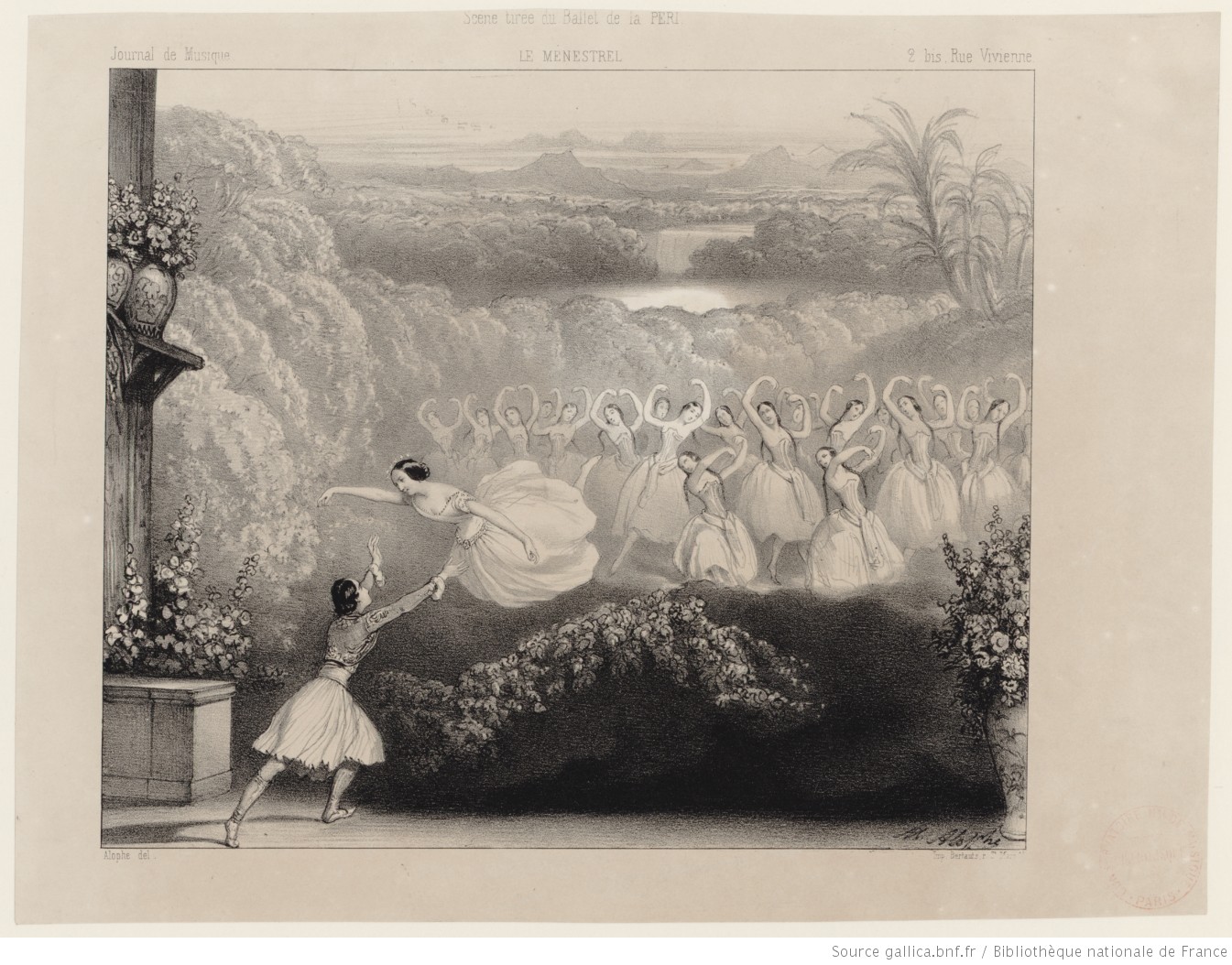
Two striking numbers were created for Grisi – the Pas du songe and the Pas de l’abeille – the former was especially impressive, but also dangerous because it featured Grisi making a very daring leap from a six-foot platform into Petipa’s arms (see fig. 6). It was for this number that Gautier asked Perrot for assistance as he was looking for advice on how to give the scene of the first encounter between the Peri and Achmet a spectacular impact. He explained to Perrot, “At this point there has to be arranged a dance such as only you can design. The peri comes up quite close to him, as if to tempt and provoke him, but when he moves towards her, she hurls herself a great distance away from him, with a single bound.”5 Perrot’s response has not survived, but it is known that he did not create a pas for Grisi or made any choreographic contributions to La Péri. It is suspected that the idea for the sensational leap in what became the Pas du songe could have been his idea. Gautier had asked for a great backward leap, which did not make its way into La Péri, but it may have stayed with Perrot and it could be where he got the idea of the backward leap for Ondine’s disappearance into the water in the first scene of Ondine, which he created and staged a few months later.
The Pas de l’abeille (Dance of the Bee) (see video 1) was performed by the Peri in disguise for Achmet and it opens with her plucking a rose and inadvertently disturbing a bee. She tries in vain to shake it off, but the angry bee buzzes around her before seeking refuge in her dress. In her struggle to rid herself of the bee, the Peri casts off pieces of her clothing one at a time, starting with her tunic, then her scarf and finally, her skirt before hiding beneath her master’s cloak. The idea of the Pas de l’abeille came from Gautier, who claimed to have heard of such a dance being performed in Egypt, as he explained to his letter to his friend visiting Cairo:
“I do not need to describe the Pas de l’Abeille, which, being at Cairo, you must have seen rendered in all its native purity, that is, if the modest Mehemet Ali has not banished every almée from Darfur, as a traveller told me recently.”6
When the decision was made to give La Péri the green light, Grisi was still was on the receiving end of unfavourable notices from the critics who stated that her dancing was declining. But whatever the critics thought, the Opéra was still very enthusiastic about Grisi to the point that they engaged her for a further three years from 1st January 1844. The negotiations for the renewal of her contract were not without difficulties, but once her new contract was signed in May 1843, everything went smoothly from there on and on the 17th July 1843, the bills announced that the new ballet La Péri would première that very evening.
Video 1: a recreation of the Pas de l’Abeille from La Péri, phrases of step material used here are derived from written notations of various veil dances recorded in Henri Justsmant’s choreographic scores by Claudia Jeschke and Robert Atwood, performed by Carolina Okolova (2013)
Libretto
The plot of La Péri is a very typical Romantic story set in the exotic. The first act takes place in the palace of the hero, Achmet, who owns a harem full of beautiful women, but nothing satisfies him. He cannot find joy anywhere in the world because he yearns for celestial love rather than terrestrial love. He takes up his opium pipe and, in his dreams, he finds himself in a radiant oasis where benevolent fairy-like creatures, the peris, are gathered about their queen. She kisses Achmet awake, and he falls madly in love with her, delighted at having finally found the ideal beauty of his dreams. He purses her, and she gives him the star that shines on her forehead as a talisman, by which, on kissing it, he can summon her at will.
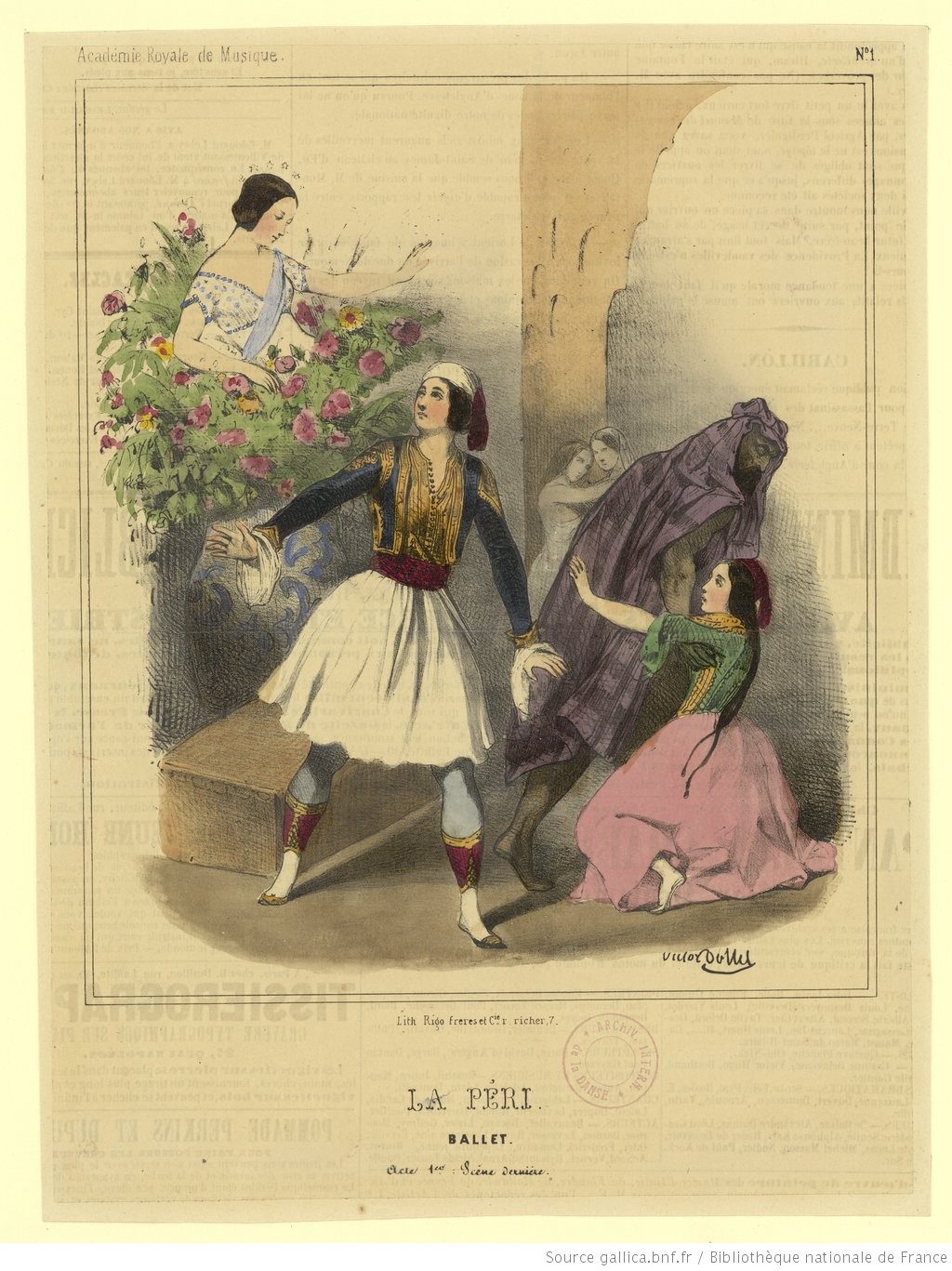
The peris then vanish and Achmet falls into a deep trance, from which his chief eunuch Roucem awakens him. He begins to tell Roucem of his vision, but on observing Roucem’s look of disbelief, he begins to wonder whether it was no more than a dream. His favourite concubine, Nourmahal tries to arouse his passion, and he seems about to yield to her when the Peri appears before him again, snatching Nourmahal’s handkerchief from his hand and replacing it with a magic bouquet. Achmet’s memory of the Peri then returns, and he places the star she gave him to his lips. The Peri reappears but chides him for being unworthy of her love and vanishes, taking the bouquet with her. Nourmahal, who has observed this scene, gives way to tears, but Achmet repulses her. Delighting in her triumph, the Peri then returns to restore the bouquet to him, while Nourmahal leaves, swearing to be avenged.

The second act opens again in Achmet’s palace. The peris flutter about the palace, while their queen peers through a window as if seeking Achmet. Suddenly, a fugitive slave girl, Leila, is seen being hotly pursued by a band of armed men. She reaches the terrace but is shot and killed. The Peri decides to enter the dead slave’s body to test Achmet’s love. When Achmet and Roucem find her, she explains that her error lay in not returning the love of her master, the Pasha, and begs Achmet to take her under his protection. Fearful of the Peri’s jealousy, Achmet treats “Leila” with reserve, but gradually warms to her and is finally captivated when, at a festival held in his honour, she performs the Pas de l’abeille. Nourmahal, consumed with jealousy, vows to be avenged, and attempts to stab first Achmet and then “Leila”, but she fails. News is then brought that the Pasha is on his way with his guards to reclaim his fugitive slave and put her to death. Amid the general confusion, Roucem is seen conducting “Leila” to an underground passage.
The scene changes to a simple prison cell, where Achmet languishing as a prisoner of the Pasha. As he mournfully contemplates his fate, the wall opens to reveal the Peri. She asks him to give up Leila and share eternal happiness with her. He refuses, and she vanishes. The Pasha then enters to give Achmet one last chance to surrender Leila to him. When Achmet refuses, the Pasha orders his men to cast him from the window to be impaled on the sharp hooks attached to the wall outside. As Achmet disappears, the walls vanish to reveal a sky of soft clouds on which the peris are gathered. The clouds then part to reveal Achmet and the Peri ascending together to Paradise.
World première
La Péri premièred on the 17th July 1843 at the Salle Le Peletier, with Grisi in the dual role of the Peri/Lelia, Lucien Petipa as Achmet and the ballerina Delphine Marquet as Nourmahal. The ballet was a wonderful success and whether Grisi’s dancing was in decline, this was what she needed to prove that she was still very her prime. Gautier, Coralli and Burgmüller had created a perfect role for her as her performance was widely praised. Her two signature pas – the pas du songe and the pas de l’abeille – were well-received. Gautier described the pas du songe as:
“… a real triumph; when she [Grisi] appeared in that luminous halo, with a child-like smile, her eyes betokening astonishment and delight, her poses like those of a bird who seeks to alight but whose wings carry her away in spite of herself, unanimous applause burst from every corner of the house. What a marvellous dance! I should very much like to see real peris and fairies! How she glides over the ground without touching it, just like a rose-leaf wafted by the breeze; and, moreover, what nerves of steel reside in that frail leg, what strength in that foot, small enough to excite the jealousy of the most daintily shod lady of Seville; how she alights on the tip of that slender toe, like an arrow falling on its barb!
At once precise and intrepid, Carlotta Grisi’s dancing has a quite special style; it does not resemble the dancing of either Taglioni or Elssler; each one of her poses, each one of her movements, is stamped with the seal of originality. How wonderful to be new in an art so limited! This pas includes a certain fall which will soon be as famous as the Niagara Falls. The audience wait for it in awed curiosity. At the moment when the vision is about to end, the Peri falls from the top of a cloud into her lover’s arms. If it were only a tour de force, we should not mention it; but this perilous leap forms a group so full of grace and charm that it suggests a dove’s feather drifting downwards, rather than a human being leaping from a platform; and here, as on many other occasions, tribute must be paid to Petipa. How devoted he is to his dancer! How he looks after her! How he supports her!”7
The critic Hippolyte Prévost gave a more precise description of the pas:
“Carlotta [Grisi] attempted some novel poses and some novel pirouettes sur les pointes, balancings, jétés, enlacements, and groups that were most wonderfully effective. But the unexpected , astonishing, extraordinary thing that crowns this pas, which is so striking from every point of view, is when Carlotta hurls herself from a six-feet-high platform, on which are seated the celestial court of the Queen of the Peris, and pirouetting on herself, falls into [Lucien] Petipa’s arms without allowing this tour de force… in any way to disturb the calculated resolution and the purity of line of the few bars of dancing that complete this… dangerous jump.”8
The Pas de l’abeille was praised and proved to be the perfect platform to display Grisi’s femininity. Gautier wrote about the pas de l’abeille:
“I wish you could see for yourself the embarrassed modesty with which Carlotta removes her long white veil; the way in which she poses as she kneels beneath its transparent folds, like the Venus of antiquity smiling from her pearly shell; the childlike fright that seizes her when the angry bee emerges from the flower, and all the hope and the anguish, and the changing fortunes of the struggle that she conveys as tunic and scarf, and the skirt which the bee has tried to penetrate, are rapidly discarded right and left and vanish in the whirl of the dance, before she drops at Achmet’s feet, breathless, exhausted, smiling through her fear, and desiring a kiss far more than the golden sequins that her master’s hands places on the brow and the breast of his slave-girl.”9
Jules Janin also wrote of the Pas de l’abeille:
“That is how one should undress in the middle of the stage – not in an unpleasant and unseemly way, with fat red hands like the pretty wenches of the Théâtre des Variétés (what insect is biting them?), but cleverly and vivaciously, and with such grace in that luminous distance.”10
La Péri would become one of Grisi’s favourite works. From March 1846, it was staged in a shortened version with the second act omitted, which did not matter much because the interest of the ballet was mainly concentrated in the first act. The best of the choreography, most notably the use of students in the kingdom of the peris scene, was preserved and there were no complaints about the removal of the scene where the fugitive slave girl Leila is shot and killed, which had caused Jules Janin to express in horror:
“What! A murder in the middle of a ballet! A poor girl shot in the heart! Blood, murder, pure blood at the Opera! What would you have thought of that, Vestris!”11
La Péri was given a total of 76 performances at the Paris Opéra between 1843 and 1853, and after Grisi’s departure, the role of the Peri/Leila was performed by Adeline Plunket and Regina Forli.
La Péri outside Paris
Several months after its première, La Péri was brought to London by Alfred Bunn, the Director of the Theatre Royal, Drury Lane at the time. The London première of La Péri was held on the 30th September 1843, with Grisi and Petipa reprising their respective roles as the Péri and Achmet.
La Péri was brought to Russia in 1844, where it vaguely survived for a limited time. In the first Russian production, the titular role was danced by Elena Andreyanova. Marius Petipa danced his brother’s role of Achmet opposite Tatyana Smirnova as the Peri/Leila in 1847. On the 30th August 1856, the first act of La Péri was performed as part of the celebration gala for the coronation of Tsar Alexander II at the Bolshoi Theatre in Moscow, with Marfa Muravieva as the Peri. The last known performance of La Péri in Russia is in the 1883-84 Saint Petersburg season when it was revived in a one-act production, but this revival proved so wretched that it was only performed once. It seems that by the turn of the 20th century, the ballet had fallen into obscurity.
Throughout the 20th century, the only piece with any connection to Burgmüller’s La Péri to be performed was a pas de deux for the Péri and Achmet. Among those to perform the so-called La Péri Pas de deux were Alicia Alonso, Carla Fracci and Lyubov Kunakova. Although the ballet was not notated, notation expert and dance historian Claudia Jeschke and Robert Atwood utilised phrases of step material derived from Henri Justament’s notations of various 19th century veil dances to recreate the Pas d l’Abeillie (see video 1).
In 2010, world-renowned dancer and choreographer Vladimir Malakhov created a new version of Burgmüller’s La Péri for the Staatsballett Berlin. Malakhov’s La Péri premièred at the Berlin State Opera House on the 27th of Feburary 2010 with Malakhov as Achmet and Diana Vishneva as the Péri/Léila. The production has since been retired from the Berlin repertoire, but Malakhov has staged excerpts from the ballet elsewhere, most notably his native Ukraine. In 2017, he staged an excerpt from his La Péri at the Grand Prix Kyiv, which was performed by students of the Kyiv State Ballet School (see video 2).
Video 2: Excerpt from Vladimir Malakhov’s La Péri at the Grand Prix Kyiv (2019)
References
- Jules Perrot: Master of the Romantic Ballet by Ivor Guest, p. 90, Dance Books UK Ltd (1984) ↩︎
- The Romantic Ballet as seen by Théophile Gautier by Théophile Gautier, translated by Cyril Beaumont, p. 61-62 (1947 ed.) ↩︎
- The Romantic Ballet in Paris by Ivor Guest, p. 368, Dance Books UK Ltd (2008) ↩︎
- The Romantic Ballet in Paris by Ivor Guest, p. 368, Dance Books UK Ltd (2008) ↩︎
- Quoted in Jules Perrot: Master of the Romantic Ballet by Ivor Guest, p. 90-91, Dance Books UK Ltd (1984) ↩︎
- The Romantic Ballet as seen by Théophile Gautier by Théophile Gautier, translated by Cyril Beaumont, p. 67 (1947 ed.) ↩︎
- The Romantic Ballet as seen by Théophile Gautier by Théophile Gautier, translated by Cyril Beaumont, p. 67 (1947 ed.) ↩︎
- Quoted in The Romantic Ballet in Paris by Ivor Guest, p. 373, Dance Books Ltd (2008) ↩︎
- From Presse. 25 July 1843, Gautier, quoted in The Romantic Ballet in Paris by Ivor Guest, p. 373-374, Dance Books Ltd (2008) ↩︎
- From Journal des débats. 19 July 1843, Janin, quoted in The Romantic Ballet in Paris by Ivor Guest, p. 374, Dance Books Ltd (2008) ↩︎
- From Journal des débats. 19 July 1843, Janin, quoted in The Romantic Ballet in Paris by Ivor Guest, p. 374, Dance Books Ltd (2008) ↩︎
Sources
- Ivor Guest (2008) The Romantic Ballet in Paris. Alton, Hampshire, UK: Dance Books Ltd
- Ivor Guest (1984) Jules Perrot: Master of the Romantic Ballet. London, UK: Dance Books Ltd
- Théophile Gautier, Cyril Beaumont (1932) The Romantic Ballet as seen by Théophile Gautier, translated by Cyril Beaumont: 1947 ed. London, UK: Wyman & Sons Ltd
- Ivor Guest (1954) The Romantic Ballet in England. Hampshire, UK: 2014 ed. Dance Books Ltd
- Ivor Guest (1953) The Ballet of the Second Empire. Middletown, Connecticut, US: 2014 ed. Pitman & Wesleyan
 The Marius Petipa Society